Prompt – A teacher who noticed something in you.
Non solum oculis.
I took Latin in high school after taking French in junior high with an evil little man who had a bad comb-over, worse teeth, and no patience for ignorant little children messing up his language. I was absolutely not going to continue with French. So I switched to Latin. Latin was a dead language, at least on paper, but it turned out to be the most alive class I had ever taken.
What I learned in that room had very little to do with memorizing declensions and everything to do with how ideas are made. Mr. Duffy taught me that thinking is not a silent, private act that happens first and then gets dressed in words. Thinking is social before it is individual. Ideas are formed through interaction, through dialogue, and only later do those shared ways of thinking move inward, where they begin to feel private and personal. Language was not an afterthought. It was the place where thinking happened.
Mr. Duffy taught that language is not a box that holds ideas. Language allows ideas to form, collide, revise, and grow. Words do not simply name thoughts. They shape them. The structure of language influences what can be noticed, compared, questioned, and remembered. He showed us that expanding language, even by adding a so-called dead one, expands cognition. I did not have an academic understanding of all this then, but I understood it intuitively. He was right.
Because of Mr. Duffy, I became interested in languages and in what becomes possible when more than one linguistic system lives in the same mind. I learned that knowing more languages does not simply add vocabulary. It adds ways of organizing experience. Each language carries its own metaphors, its own logic, its own relationships between time, action, and responsibility. The more languages a person has access to, the more tools they have for connecting ideas, negotiating meaning, and making sense of the world with depth instead of speed.
Mr. Duffy noticed this curiosity about language in me before I did. He shared his thinking about language and life without making it feel like something that needed to be swallowed whole. He taught us Horace, the Roman poet made known by a new generation because of Dead Poets Society, and he used that film to draw us in and teach. He understood that attention is earned, not demanded.
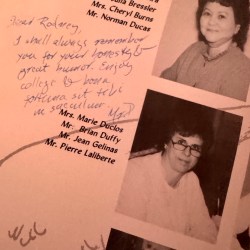
Recently, I found my old senior year book, and inside it he had written that he would always remember me for my honesty and my sense of humor. That line landed harder than it probably should have. He did not praise intelligence or achievement. He named qualities that suggested presence, risk, and a willingness to say what was true even when it was inconvenient.
Looking back now, I understand that what he really noticed was not an aptitude for Latin. He noticed a hunger for connection and a comfort with language as a living thing. He saw the possibility of a life built around words, meaning, and noticing, and he named it out loud. That naming mattered. There are moments when a teacher does not give you something new, but instead reflects something back to you that you had not yet trusted. Sometimes being seen is not about praise. Sometimes it is about recognition arriving early enough to change the shape of a life.
Thank you, Mr. Duffy.
| M | T | W | T | F | S | S |
|---|---|---|---|---|---|---|
| 1 | ||||||
| 2 | 3 | 4 | 5 | 6 | 7 | 8 |
| 9 | 10 | 11 | 12 | 13 | 14 | 15 |
| 16 | 17 | 18 | 19 | 20 | 21 | 22 |
| 23 | 24 | 25 | 26 | 27 | 28 | 29 |
| 30 | 31 | |||||
 Muddled Soma