
What Should Have Happened

I have not written my 500 words in a while. A few people have reached out to ask why. So, why not write 500 words about that! The lie I tell myself is that life got busy. The authentic answer I have not been interested in facing is that it started to hurt beyond what I could bear.

For months, I sat down every day and gave myself over to the keyboard. Some days the words came easily. Most days they did not. I thought I was spending a year writing about coming of age, but that was fucking naïve. I was trying to become the little boy who finally mattered. That is the lie old wounds tell. If I can remember hard enough, explain it well enough, or tell the story one more time, maybe I can negotiate a better childhood. Of course, that deal does not exist. The past has never renegotiated a better contract.

I believe adulthood begins when I finally let go of the childhood I did not get. I have not been able to shake that thought.

When I look back through my writing and my memories, I realize I have carried two sets of recollections for most of my life. There are the memories of what happened, and then there are the memories of what should have happened. Oddly enough, it is the second set that has always been heavier. They have followed me into relationships, parenting, work, travel, and eventually into my writing. Without realizing it, I was asking 500 words a day to build a bridge backward instead of forward. Every sentence became another attempt to earn something that should have been freely given to a little boy decades ago. No wonder I was so fucking exhausted!

I finally realized the pain was not coming from remembering. It was coming from hope. Hope that one more page, one more memory, one more honest paragraph might somehow change yesterday. I kept trying to convince the past to tell a different story. It never did as some stories are not waiting to be rewritten. They are waiting to be grieved.

Nobody talks much about grieving the childhood that never happened. I am not talking about pretending everything was terrible. I am talking about grieving the hugs that never came, the words that were never spoken, and the moments that quietly shaped my understanding of my own worth. I think there are versions of me that never had the chance to exist because I spent so much energy trying to become enough for someone else.

No one is coming to hand that little boy the childhood he deserved. There is no hidden chapter where everything suddenly makes sense and everyone finally says what I needed to hear. There is only me… now. And I am a fifty-two-year-old man who refuses to spend the rest of my life dragging that kid into the future, hoping tomorrow will somehow fix yesterday. Instead, I choose to sit beside him, thank him for surviving, and tell him he does not have to keep fighting anymore.

I still believe writing saves lives. It certainly has helped save mine. I just finally realized I was asking it to do something it could never do. I was asking words to resurrect the past instead of helping me live more honestly in the present.

Maybe growing up is not becoming someone new. Maybe it is accepting that childhood has no do-overs, nor can it be completed at a later date. It cannot be repaired by achievement, success, travel, love, or another five hundred words. Adulthood begins the moment I stop asking today to pay yesterday’s debts.

I think I finally understand why those 500 words became so painful. I was not writing to remember. I was writing to recover something that was never coming back. There is a difference.

The real work was never bringing that little boy back, but rather thanking him for surviving… and finally letting him rest.

July 2026
M T W T F S S
 12345
6789101112
13141516171819
20212223242526
2728293031  

Identity: Annotated in the Margins – Day 50

Prompt – Outgrowing an identity.

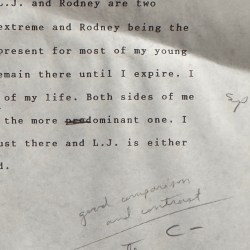
I wrote the paper I mentioned in my previous post before I knew I was actually beginning to draw a map. Back then I thought I was explaining two people, Rodney and Lj, like they were characters in a story. One careful. One loud. One polite enough to be invited to dinner. One reckless enough to laugh at the invitation. I thought I was making sense of opposites. I did not realize I was documenting my survival up to that point.

Rodney was the name that arrived first. It came with expectations and rules and the quiet understanding that good children did not take up too much space. Rodney knew how to observe, how to blend, how to make himself acceptable in rooms that did not always feel safe. Rodney watched more than he spoke. Rodney carried the weight of being seen as good because being good felt like protection.

Lj came later, but he felt older somehow. He showed up in locker rooms and late conversations and moments when the rules stopped making sense. Lj said what Rodney swallowed. Lj used language like a blade and a bridge at the same time. He did not wait for permission. He did not soften edges just to make others comfortable. Back then I called him the “bad” extreme. Now I think he was just more authentic and honest.

Reading that old paper now feels like opening a time capsule written by someone who knew more than he admitted. I can hear the younger version of me trying to organize identity into categories; good versus bad, reckless versus respectable, loud versus quiet. He needed the world to be that simple because he had not yet learned that both voices were trying to keep him alive.

The truth is that Rodney and Lj were never enemies. They were translators for each other. Rodney understood the cost of words; Lj understood the cost of silence. Rodney held the map; Lj lit the match. Somewhere between the two, a writer started to form.

I think about how often I moved as a kid, how every new base felt like an invitation to reinvent myself. Identity was never fixed; it was something I packed in a suitcase and tried on again when the walls changed. That paper captured the moment when I first noticed that reinvention had a pattern. I did not become someone new; I just shifted which part of me was allowed to speak.

There is something tender about the younger voice calling Lj loved or hated but never ignored. I hear a kid trying to make sense of visibility after years of practicing invisibility. He did not yet know that being seen would come with its own kind of grief, that every word spoken out loud would echo longer than expected.

What surprises me most is not how different I sound now, but how familiar that voice feels. The metaphors were already there. The obsession with language was already there. Even the quiet awareness that identity was not a single story but a conversation between versions of myself had already begun.

Maybe this happen when returning to old pages; not to correct them, but to recognize the person who was brave enough to start writing before he knew where the story was going.

Rodney is still here. He always will be. He is the part of me that pauses before speaking, the part that listens for the unsaid. Lj is still here too, louder now, less interested in apologizing for taking up space. They no longer feel like extremes. They feel like witnesses to each other.

If I could speak to the kid who turned that paper in, the one who received a modest grade and moved on, I would tell him this: you were not describing two personalities. You were describing the beginning of a voice that would take decades to understand itself.

And maybe that is the real battle. Not outgrowing Rodney or Lj or any other identity, but learning how to let them all sit at the same table without one trying to replace the others. But seriously, a C-? WTF!

Piercing the Silence – Day 17

Prompt – A time that the role you played in your family cracked or stopped fitting.

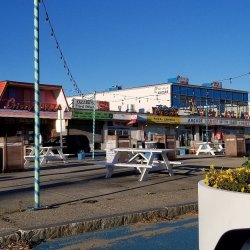
I never found Salisbury Beach to be subtle. It did not whisper. It announced itself with salt hanging heavy in the air, fried dough grease clinging to clothes, and the low mechanical groan of rides that had already lived several lifetimes past their prime. The boardwalk felt stitched together from weathered planks, cigarette butts, suntan lotion, and memory, each step resting on layers of use and neglect that no one bothered to hide.

The boardwalk was loud in a way that felt earned, and I understood that kind of noise, as I lived close to Massachusetts, rough and entirely unapologetic. Arcade bells rang like slot machines, triggered by quarters warmed in palms that had already lost far too many and still kept feeding the machines anyway. Everything about Salisbury felt temporary and permanent at the same time. Rust showed through peeling paint. The ancient ocean breathed steadily just beyond the chaos, indifferent to the noise, the prizes, and the bravado. And still, the boardwalk pulsed with life, a narrow strip of wood holding together sound, sugar, salt, and the stubborn insistence that summer might last just a little longer.

I watched teenagers strut in loose packs, performing indifference while carefully cataloging everything around them. Eyes slid past one another on purpose, yet nothing escaped notice: tank tops, cutoffs, and hair stiff with salt and AquaNet. Every glance carried calculation, and every laugh landed a little too loud, revealing confused confidence. Everyone was playing a role and trying on identities that only summer allowed. Some aimed for tough, others for untouchable, desired, dangerous, or simply older than they were. The boardwalk served as the stage, the crowd became the mirror, and becoming someone new felt possible as long as the lights stayed on and the night refused to end.

I went to Salisbury Beach in Buckie’s 1982 brown Ford LTD that smelled like vinyl, heat, and his mother’s lipstick stained Virginia Slims butts still sitting in the ashtray. I wanted to get my ear pierced on the boardwalk. I wanted proof that I could change something about myself, even if it was small and permanent at the same time. I knew my father would flip out. I carried that knowledge with me the whole ride, heavy but no longer enough to stop me. I was sixteen and exhausted from being quiet and observant. I was tired of shrinking. Tired of watching life happen from the edges. That hole made by the needle was not about jewelry. It was about choosing to be heard, choosing to be seen, and deciding that silence was no longer the safest version of who I could be.

When I got home, my father did exactly what I expected. He unloaded every fear he carried about himself into me as certainty. I would never find a job. I was unworthy. I was a failure, just like my brother. The words came fast and sharp. But something had shifted. The role I had played my whole life no longer fit the moment. Observation failed me. Silence offered no protection. Keeping the story suddenly felt like complicity.

So I spoke. Not carefully. Not strategically. I told him to go fuck himself.

That was the crack. The moment the observer stopped being useful. The moment the storyteller stepped into the story and risked becoming the problem instead of the witness. I did not become safer that night. I became louder. And once I crossed that line, there was no returning to the quiet child who believed that watching was enough.

July 2026
M T W T F S S
 12345
6789101112
13141516171819
20212223242526
2728293031  

Finders Keepers – Day 16

Prompt – What role did you play in your family?

I was the baby in my family. My brother and sister were older than me by several years, old enough that by the time I reached preteen age, they were already gone. My brother went into the military. My sister married into the military. Apparently, the military was the family business. The house grew quieter. The orbit shifted.

As the baby, I watched. Silence felt safe. Observation felt necessary. While others reacted, I absorbed. While the room moved, I stayed still long enough to understand what was actually happening. Being the youngest meant I was present without authority. Decisions were made above my pay grade and explanations were optional at best. I learned to read tone before words and posture before intention. I noticed how laughter sometimes arrived too quickly, how stories and jokes could function like smoke, how playfulness could smooth over things no one wanted to face directly. I understood the role of distraction even when I refused to perform it. Instead of entertaining, I studied the moment the room needed to be entertained.

I became the observer because no one asked me to be anything else. I was small enough to disappear and quiet enough to be underestimated. That invisibility became access. I watched tension build and release. I watched who needed to be soothed and who needed to stay unaware. I noticed who carried the emotional weight and who benefited from keeping it unnamed. I learned that some roles exist to protect the system rather than the people inside it. Those patterns mattered to me even when naming them made others uncomfortable.

Somewhere in all that watching, I became the storyteller. Not the loud one. Not the funny one. Just the keeper of the stories. I held the version of events that existed before they were softened. I remembered what came before the joke and what never made it into the retelling. I learned that stories shift depending on who is listening and that truth is often traded for comfort without anyone admitting the exchange.

The storyteller role was lonely. It meant holding meaning without a place to set it down. It meant knowing things too early or too clearly. It meant understanding that telling the truth outright could destabilize a balance everyone depended on, even if that balance was fragile and false. So I learned patience. I learned restraint. I learned to let stories mature until they could be told without blowing the room apart. I learned that timing matters as much as honesty.

I did not soothe my family through story. I soothed myself by understanding the stories. I organized chaos into narrative, or at least I tried to. I tracked cause and effect. I stitched moments together into something coherent so I could survive them. That instinct followed me into adulthood, into classrooms, into leadership, into writing. I still sit quietly at first. I still watch how people move when they think no one is paying attention. I still tell stories not to entertain, but to reveal.

July 2026
M T W T F S S
 12345
6789101112
13141516171819
20212223242526
2728293031  

Exit Through the Gift Shop – Day 13

Prompt – What did conflict look like in your home?

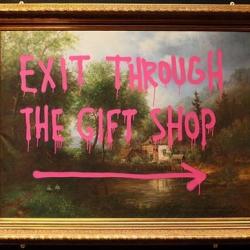
In the museum that was my family, exhibits were arranged with great care, but no one ever explained how to walk through the space and appreciate it. There were rules, but they were invisible. There were expectations, but they were never spoken aloud. Reverence was required, though no one ever showed what reverence looked like. Conflict rose and settled, mostly silent, like high blood pressure. It was present and deadly.

I was expected to know how to move, how to speak, how to respond, without ever being taught. Love was supposed to be understood. Respect was supposed to be automatic. No questions. If something felt off, it was never the environment. It was me. If someone felt unseen, it became my responsibility to fix it, even when I did not know what was broken.

There was very little modeling and no learning together. There was quiet judgment when the performance did not match the script that existed inside someone else’s imagination. So I studied faces and read spaces the way visitors study paintings. I read silence the way curators study cracks in marble. I anticipated needs that were never spoken. Over time, I confused vigilance with care. I confused fear with respect. I confused self-erasure with love.

Having my own family, I know that healthy families teach. They model love for each other. They meet you where you are. They invite you into the room instead of scolding you for not knowing the path. They offer maps. They offer language. They practice connection in the open, not behind glass. They make mistakes out loud. They apologize out loud. They are noisy. They are alive.

I am still unlearning the rules of the gallery. I am still learning that I do not have to bow to every display or stop at every exhibit. I am allowed to ask questions. I am allowed to exist in the room without shrinking to fit someone else’s idea of beauty. I am allowed to walk past what harms me. Little by little, I choose different architecture for my own family. There are far fewer exhibits and a hell of a lot more living. I teach my children that conflict is not something to fear. It is something we move through together. I make space for mistakes. I say what I feel and let them say what they feel. We practice beginning again. We learn in the open.

Sometimes the old museum haunts me with its polished floors and quiet shame. Sometimes I still find myself whispering in rooms that no longer require my silence. But I notice it now. I pause and I breathe. I set down the old way.

As an adult, I am beginning to believe something I could not have imagined as a child: love is not earned through performance. Love is not proven through suffering. Love grows in rooms where people are allowed to exist as they are.

The museum will always be part of my story, but I am learning how to walk out of the gallery without carrying the blame as a souvenir.

July 2026
M T W T F S S
 12345
6789101112
13141516171819
20212223242526
2728293031