Prompt – Outgrowing an identity.
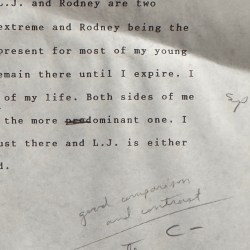
I wrote the paper I mentioned in my previous post before I knew I was actually beginning to draw a map. Back then I thought I was explaining two people, Rodney and Lj, like they were characters in a story. One careful. One loud. One polite enough to be invited to dinner. One reckless enough to laugh at the invitation. I thought I was making sense of opposites. I did not realize I was documenting my survival up to that point.
Rodney was the name that arrived first. It came with expectations and rules and the quiet understanding that good children did not take up too much space. Rodney knew how to observe, how to blend, how to make himself acceptable in rooms that did not always feel safe. Rodney watched more than he spoke. Rodney carried the weight of being seen as good because being good felt like protection.
Lj came later, but he felt older somehow. He showed up in locker rooms and late conversations and moments when the rules stopped making sense. Lj said what Rodney swallowed. Lj used language like a blade and a bridge at the same time. He did not wait for permission. He did not soften edges just to make others comfortable. Back then I called him the “bad” extreme. Now I think he was just more authentic and honest.
Reading that old paper now feels like opening a time capsule written by someone who knew more than he admitted. I can hear the younger version of me trying to organize identity into categories; good versus bad, reckless versus respectable, loud versus quiet. He needed the world to be that simple because he had not yet learned that both voices were trying to keep him alive.
The truth is that Rodney and Lj were never enemies. They were translators for each other. Rodney understood the cost of words; Lj understood the cost of silence. Rodney held the map; Lj lit the match. Somewhere between the two, a writer started to form.
I think about how often I moved as a kid, how every new base felt like an invitation to reinvent myself. Identity was never fixed; it was something I packed in a suitcase and tried on again when the walls changed. That paper captured the moment when I first noticed that reinvention had a pattern. I did not become someone new; I just shifted which part of me was allowed to speak.
There is something tender about the younger voice calling Lj loved or hated but never ignored. I hear a kid trying to make sense of visibility after years of practicing invisibility. He did not yet know that being seen would come with its own kind of grief, that every word spoken out loud would echo longer than expected.
What surprises me most is not how different I sound now, but how familiar that voice feels. The metaphors were already there. The obsession with language was already there. Even the quiet awareness that identity was not a single story but a conversation between versions of myself had already begun.
Maybe this happen when returning to old pages; not to correct them, but to recognize the person who was brave enough to start writing before he knew where the story was going.
Rodney is still here. He always will be. He is the part of me that pauses before speaking, the part that listens for the unsaid. Lj is still here too, louder now, less interested in apologizing for taking up space. They no longer feel like extremes. They feel like witnesses to each other.
If I could speak to the kid who turned that paper in, the one who received a modest grade and moved on, I would tell him this: you were not describing two personalities. You were describing the beginning of a voice that would take decades to understand itself.
And maybe that is the real battle. Not outgrowing Rodney or Lj or any other identity, but learning how to let them all sit at the same table without one trying to replace the others. But seriously, a C-? WTF!

 Muddled Soma