
Detours and Dead Letters – Day 34

Prompt – How the Friendship Changed

This is part three of a three prompt series. The first post is here and the second post is here.

Jeremy and I did not explode. There was no betrayal, no raised voices, no dramatic final scene with the kind of closure often found in movies with an amazing music and video montage. The friendship changed the way military friendships usually change. One day, the routine is intact. The next day, a family is loading boxes, a moving truck is idling, and the neighborhood has a new vacancy. One day we were hanging out during recess. The next day, he was going back to Texas.

In my mind, it felt like leaving. For Jeremy, it was a homecoming. He acted like the universe was correcting a mistake. He was a Texan through and through. He loved the heat and was ready to say goodbye to the winters. Alaska was, at best, an interruption for him…a detour. Texas was a return. I understood that much, even at that age. Still, understanding did not make his leaving hurt less.

We both said the things kids say when adults are listening. We promised to keep in touch. We said we would write. We said we would call when we could. And of course, we said we would not forget. Those sentiments were offered like bandages, thin and polite, as if language could seal up the gaping wound not even fully realized yet.

I upheld my part of the promise, writing him every week. Jeremy did not. I remember the ritual of writing him more than what I wrote him. I used the same pad of paper every time. I tried to make our ordinary days sound interesting, worth staying connected to. I narrated the small things because small things were what connected us. I wrote about a new snow fort, “our” new teacher, and the new kid who moved into his old house. I folded the letter carefully, far too small, slid it into the envelope, wrote his address, and then I waited.

He never responded. Not one time. At first, I worked hard to excuse his silence. I invented reasons for the friendship to remain intact, even if only on my side of the map. Maybe the mail got lost. Maybe his mother forgot to buy stamps. Maybe he wrote back and it disappeared into some military black hole where all the missing things go. I was loyal, and I was young enough to believe that if I kept showing up, the world would meet me halfway.

Then, slowly, I realized a letter was not coming. I was writing to myself. I was crushed for a long time, and I never talked about it. It did not look like grief adults would recognize. It looked like me becoming even more careful and small.

I did not make another best friend until two moves later, at Plattsburgh Air Force Base. Between Jeremy and Plattsburgh, I learned a lesson that felt less like wisdom and more like a bruise that never healed.

People say they will write. People say they will call. People say whatever they need to say in the last hour before goodbye because the truth is too sharp to hold in your mouth. When people are not close to one another anymore, even if they once were, shit changes. Distance does not just stretch a friendship. It edits it. It removes the ordinary moments that keep love warm and alive. It replaces them with intention, and intention is harder to sustain than people admit because it requires work.

Looking back, I can see something tender under the damage. I kept writing because connection mattered to me. I believed in continuity, even when my life trained me in detours. That belief did not save the friendship, but it revealed something about me. I was the kind of kid who tried to build a bridge. I was the kind of kid who stayed, even when someone else did not.

And maybe that is the quiet hope inside the story. The friendship changed, and it hurt. It left a mark. But it also showed me, early, that I was capable of devotion, of showing up, of loving in a way that was not performative. The loss taught me caution, yes. But the writing taught me something else too. It taught me that my instinct, even then, was to reach out, to connect, to make meaning, so I could stay human in a life designed around leaving.

January 2026
M T W T F S S
 1234
567891011
12131415161718
19202122232425
262728293031  

Adventures in Moving: ALCAN Edition – Day 15

Prompt – A family story that shaped how you saw yourself.

Family stories are told around the table to remind us who we have been and how we survived becoming who we are. They keep history alive, not in textbooks or archives, but in voices that know where to pause and when to laugh. Sometimes these stories shape how we see ourselves. Other times, they simply allow us to recognize ourselves inside someone else’s memory, and how we are seen outside of ourselves. In that recognition, connection happens. Not because our lives matched, but because the feeling did, or at least should have?

These stories carry more than nostalgia. They show us how anger was handled, how grief was avoided or honored, how love showed up…or did not show up. Long before anything happens to us, we have already been taught, quietly, how we are supposed to respond by who speaks, who stays silent, who fixes things, and who leaves the table early.

Family stories teach us what is celebrated and what is buried. They reveal which parts of the truth are told with ease and which ones are edited for comfort. Over time, I realized that I did not just inherit eye color or mannerisms. I inherited scripts. Expectations. Reflexes. The way a future moment might unfold has often already been practiced in the retelling of the past. Listening closely gives me a choice. I can honor the story without repeating it exactly. I can keep the memory alive while deciding how the next chapter sounds when my voice enters the room.

This story was told repeatedly in my family and has offered me wise counsel for my future self. My family was moving from March Air Force Base in Los Angeles, California to Elmendorf Air Force Base in Alaska. Of course, we drove. Military families often drive because it is cheaper, longer, and character building in all the wrong ways – Adventures in Moving™. The highway that connects the lower forty-eight states to Alaska is the ALCAN Highway. It was still unfinished even in the early 1980’s. Smooth pavement would suddenly disappear into gravel, potholes, and dust. Civilization vanished for long stretches. It was a road that demanded endurance and offered very little grace in return.

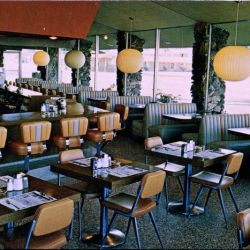
Somewhere in Canada, we stopped at a small diner. The kind with thin walls, vinyl booths, and a quiet that made every sound matter. We sat down, ordered drinks, and tried not to look like exactly what we were: a tired military family passing through a place that was not ours. My father got up to use the bathroom.

What happened next became legend.

The bathroom walls betrayed him, loudly and repeatedly. The sounds were unmistakable and entirely public. They echoed through the thin walls and into the dining room. Every person in that restaurant knew exactly what was happening. There was no hiding it. No dignity left to salvage.

My mother did not laugh. She did not smile. She did not lean into the absurdity of it. She stood up, gathered us, and marched us out of the diner in silence. We waited outside by the car, humiliated and rigid, while my father finished what should have been a private moment. When he came out and realized we had left, there was no humor. No apology. No acknowledgment of how ridiculous or human the moment was. There was only anger and tension.

This is the part that has stayed with me over the years. No one softened the moment. No one repaired it. No one said I am sorry or this is funny or we will laugh about this later. It was a shared experience that somehow belonged to no one and taught nothing except how not to be together. That story shaped me because it taught me what I wanted instead of that.

I wanted someone to laugh with. I wanted someone who could sit in discomfort and still choose kindness. I wanted apologies to exist, even for small things. I wanted mistakes to be survivable. I wanted love that could handle embarrassment without turning it into punishment. I wanted partnership!

Life is not fully paved. It shifts without warning. Smooth moments give way to rough stretches. What matters is not the road itself, but who you ride with and how you treat each other when the pavement disappears. That diner taught me that silence can wound more deeply than noise. And it taught me, very early, the kind of person I hoped to become when the road got rough.

January 2026
M T W T F S S
 1234
567891011
12131415161718
19202122232425
262728293031  

On the Edge of After – Day 11

Prompt – A time you wanted to be younger again.

The piano opened first with a simple and steady melody, like someone knocking softly on a door they were not sure was the correct one. It felt hesitant and determined at the same time, as if grief and hope agreed to share the same bench and the same keys. The singer did not arrive with rockstar swagger, but like a sinner entering a confessional. His voice carried a tremor that lived just behind the note, a thin crack that told the truth long before the lyrics did. There was a pleading quality there. Not begging. Just longing for a different outcome than the one that already felt written.

The drums slid in, not loud, not dramatic, simply present like a heartbeat that remembered it had work to do. The song continued to build without rushing. Each layer came in carefully, the guitar weaving around the piano like hands trying to help without making things worse. Nothing in the mix tried to show off. Everything served the ache.

How to Save a Life played on the radio on my way out of Japan as Holly drove me toward the airport in April of 2007. The world felt both too big and too small at the same time. With my bags packed and goodbyes said too quickly, it felt like a chapter was closing without the dignity of a final paragraph. I did not know then how much that song would follow me, like a ghost that refused to leave the room.

There was a part of me that wanted to be younger in that moment. Younger and untouched back in 1999. Younger and unaware back in 1999. I wanted the version of life where choices did not echo so loudly, where leaving did not feel like breaking something inside my own chest. That quiet piano line carried the weight of questions I did not have the courage to ask. What could have been different? What should have been done or not done? What part of myself was I leaving behind without realizing it? What I was carrying with me “home”?

The song did not offer comfort. It did not fix anything. It simply sat beside me, naming the ache I could not yet name. As the chorus rose, I realized that some moments mark a before and an after. In that moment, I wanted to be younger. I wanted to be back in 1999 when I arrived in Japan, when mistakes felt smaller and outcomes did not carry so much weight. I wanted to be less worn out by the world and more untouched by loss. It was not nostalgia. It was grief disguised as wishing.

When the chorus lifted, it felt like someone replaying a conversation in their mind, hoping that if the words repeated long enough, the past might loosen its grip. The music did not save anything. It stayed and witnessed the silence between notes to speak the parts that hurt the most. By the end, the repetition became prayer and punishment at once. If only. If only. If only. The piano never stopped. It kept moving forward, even when the voice sounded like it might not. That was the tender cruelty. Time kept going. The song kept going. The loss remained.

And still, something else lived there too. A quiet thread of hope, not loud, not heroic, not cinematic. Just the steady recognition that I was still here. That the ache did not erase the love of Japan and my time there had indeed been real. That leaving did not cancel the life that had been lived. Inside that ache, a stubborn spark refused to vanish. It was not redemption and not resolution. It was the fragile belief that naming the truth, even when it hurt, could keep me from turning numb.

Maybe growing older does not steal everything. Maybe it gives language to feelings that once lived unnamed in the dark, and maybe that language makes the weight lighter to carry. Not gone. Not fixed. Simply held with more honesty and a little more gentleness.

Where did I go wrong? I lost a friend
Somewhere along in the bitterness
And I would have stayed up with you all night
Had I known how to save a life

January 2026
M T W T F S S
 1234
567891011
12131415161718
19202122232425
262728293031