Terms and Conditions – Day 35

Prompt – A falling-out that still sting.

Friends come and go. That has always been the deal. It was the quiet contract of the military, the rotating cast of names and addresses that followed me from place to place. College became the same kind of temporary, only dressed up in credit hours, retention rates, and being “mature” about it all. People arrived, people disappeared, and then people became a story told in passing.

After graduation, shortly following a quick stint as an accountant, Kari and I moved to Japan for a teaching job that came with a built-in expiration date. The contracts were one year, which allowed for a tidy little ending. The Japanese school system also had a way of enforcing impermanence. Teachers were moved around periodically, as though the goal was to prevent deep bonds from forming. It felt almost religious, like attachment itself was a rule that was not supposed to be broken. I broke it anyway.

In Japan, I was an expat with a small group of young, inexperienced teachers. We were all hungry for belonging, and we were far enough from home that the hunger got louder. We did life together in full. We carried the hard parts and the easy parts, and we laughed at the absurd parts that only make sense when daily life is built in a language that still feels borrowed. We became tight, not in a casual way, but in the way people do when they become each other’s lifeline in a foreign country.

It was beautiful. It was real. It was the kind of closeness that made ordinary days feel like a story worth keeping.

When we returned home, we tried to bring the bond with us. We talked about forming a team of four couples to go back to work as missionaries – whatever the fuck that meant! We met a few times to dream and map out a future that felt like a second chance at that Japan closeness. I let myself believe it could happen. I let myself imagine a circle that would hold.

There was a lunch get-together. Kari and I were not invited. Later, someone lied about it with the kind of polite, church-friendly dishonesty that is supposed to keep the peace while it quietly kills the truth. Eventually, one person came clean, and in that moment I remembered why I used to prefer transient relationships.

I had broken the rules. I had allowed myself to get close. I had allowed myself to love people, not as passing characters, but as anchors. I had trusted the story. I had trusted the holy language people use when they want to make ordinary friendship feel sanctioned and permanent.

Love hurts when it ends. This one stung because it was real. It was tied to some of the most beautiful years of my life, and it was wrapped in religion like a ribbon that also functioned as a blindfold. The pain was not the lunch. The pain was the realization that the bond had terms and conditions, and I had not been told what they were until I failed them. Even now, the sting still registers because the years were real. Japan was real. The laughter was real. The belonging was real. A single lunch betrayal cannot erase that, even if it tried.

Some friendships are seasonal. Some are sacred. Some are both, right up until they are not. I can grieve what ended without pretending it never mattered. I can hold the good years in one hand and the betrayal in the other and finally stop forcing them to cancel each other out.

March 2026
M T W T F S S
 1
2345678
9101112131415
16171819202122
23242526272829
3031  

Adventures in Moving: ALCAN Edition – Day 15

Prompt – A family story that shaped how you saw yourself.

Family stories are told around the table to remind us who we have been and how we survived becoming who we are. They keep history alive, not in textbooks or archives, but in voices that know where to pause and when to laugh. Sometimes these stories shape how we see ourselves. Other times, they simply allow us to recognize ourselves inside someone else’s memory, and how we are seen outside of ourselves. In that recognition, connection happens. Not because our lives matched, but because the feeling did, or at least should have?

These stories carry more than nostalgia. They show us how anger was handled, how grief was avoided or honored, how love showed up…or did not show up. Long before anything happens to us, we have already been taught, quietly, how we are supposed to respond by who speaks, who stays silent, who fixes things, and who leaves the table early.

Family stories teach us what is celebrated and what is buried. They reveal which parts of the truth are told with ease and which ones are edited for comfort. Over time, I realized that I did not just inherit eye color or mannerisms. I inherited scripts. Expectations. Reflexes. The way a future moment might unfold has often already been practiced in the retelling of the past. Listening closely gives me a choice. I can honor the story without repeating it exactly. I can keep the memory alive while deciding how the next chapter sounds when my voice enters the room.

This story was told repeatedly in my family and has offered me wise counsel for my future self. My family was moving from March Air Force Base in Los Angeles, California to Elmendorf Air Force Base in Alaska. Of course, we drove. Military families often drive because it is cheaper, longer, and character building in all the wrong ways – Adventures in Moving™. The highway that connects the lower forty-eight states to Alaska is the ALCAN Highway. It was still unfinished even in the early 1980’s. Smooth pavement would suddenly disappear into gravel, potholes, and dust. Civilization vanished for long stretches. It was a road that demanded endurance and offered very little grace in return.

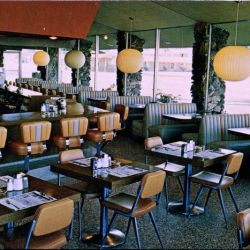
Somewhere in Canada, we stopped at a small diner. The kind with thin walls, vinyl booths, and a quiet that made every sound matter. We sat down, ordered drinks, and tried not to look like exactly what we were: a tired military family passing through a place that was not ours. My father got up to use the bathroom.

What happened next became legend.

The bathroom walls betrayed him, loudly and repeatedly. The sounds were unmistakable and entirely public. They echoed through the thin walls and into the dining room. Every person in that restaurant knew exactly what was happening. There was no hiding it. No dignity left to salvage.

My mother did not laugh. She did not smile. She did not lean into the absurdity of it. She stood up, gathered us, and marched us out of the diner in silence. We waited outside by the car, humiliated and rigid, while my father finished what should have been a private moment. When he came out and realized we had left, there was no humor. No apology. No acknowledgment of how ridiculous or human the moment was. There was only anger and tension.

This is the part that has stayed with me over the years. No one softened the moment. No one repaired it. No one said I am sorry or this is funny or we will laugh about this later. It was a shared experience that somehow belonged to no one and taught nothing except how not to be together. That story shaped me because it taught me what I wanted instead of that.

I wanted someone to laugh with. I wanted someone who could sit in discomfort and still choose kindness. I wanted apologies to exist, even for small things. I wanted mistakes to be survivable. I wanted love that could handle embarrassment without turning it into punishment. I wanted partnership!

Life is not fully paved. It shifts without warning. Smooth moments give way to rough stretches. What matters is not the road itself, but who you ride with and how you treat each other when the pavement disappears. That diner taught me that silence can wound more deeply than noise. And it taught me, very early, the kind of person I hoped to become when the road got rough.

March 2026
M T W T F S S
 1
2345678
9101112131415
16171819202122
23242526272829
3031