Prompt – A time that the role you played in your family cracked or stopped fitting.
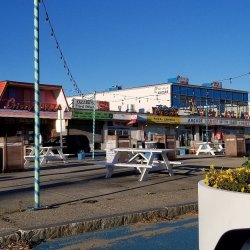
I never found Salisbury Beach to be subtle. It did not whisper. It announced itself with salt hanging heavy in the air, fried dough grease clinging to clothes, and the low mechanical groan of rides that had already lived several lifetimes past their prime. The boardwalk felt stitched together from weathered planks, cigarette butts, suntan lotion, and memory, each step resting on layers of use and neglect that no one bothered to hide.
The boardwalk was loud in a way that felt earned, and I understood that kind of noise, as I lived close to Massachusetts, rough and entirely unapologetic. Arcade bells rang like slot machines, triggered by quarters warmed in palms that had already lost far too many and still kept feeding the machines anyway. Everything about Salisbury felt temporary and permanent at the same time. Rust showed through peeling paint. The ancient ocean breathed steadily just beyond the chaos, indifferent to the noise, the prizes, and the bravado. And still, the boardwalk pulsed with life, a narrow strip of wood holding together sound, sugar, salt, and the stubborn insistence that summer might last just a little longer.
I watched teenagers strut in loose packs, performing indifference while carefully cataloging everything around them. Eyes slid past one another on purpose, yet nothing escaped notice: tank tops, cutoffs, and hair stiff with salt and AquaNet. Every glance carried calculation, and every laugh landed a little too loud, revealing confused confidence. Everyone was playing a role and trying on identities that only summer allowed. Some aimed for tough, others for untouchable, desired, dangerous, or simply older than they were. The boardwalk served as the stage, the crowd became the mirror, and becoming someone new felt possible as long as the lights stayed on and the night refused to end.
I went to Salisbury Beach in Buckie’s 1982 brown Ford LTD that smelled like vinyl, heat, and his mother’s lipstick stained Virginia Slims butts still sitting in the ashtray. I wanted to get my ear pierced on the boardwalk. I wanted proof that I could change something about myself, even if it was small and permanent at the same time. I knew my father would flip out. I carried that knowledge with me the whole ride, heavy but no longer enough to stop me. I was sixteen and exhausted from being quiet and observant. I was tired of shrinking. Tired of watching life happen from the edges. That hole made by the needle was not about jewelry. It was about choosing to be heard, choosing to be seen, and deciding that silence was no longer the safest version of who I could be.
When I got home, my father did exactly what I expected. He unloaded every fear he carried about himself into me as certainty. I would never find a job. I was unworthy. I was a failure, just like my brother. The words came fast and sharp. But something had shifted. The role I had played my whole life no longer fit the moment. Observation failed me. Silence offered no protection. Keeping the story suddenly felt like complicity.
So I spoke. Not carefully. Not strategically. I told him to go fuck himself.
That was the crack. The moment the observer stopped being useful. The moment the storyteller stepped into the story and risked becoming the problem instead of the witness. I did not become safer that night. I became louder. And once I crossed that line, there was no returning to the quiet child who believed that watching was enough.
| M | T | W | T | F | S | S |
|---|---|---|---|---|---|---|
| 1 | ||||||
| 2 | 3 | 4 | 5 | 6 | 7 | 8 |
| 9 | 10 | 11 | 12 | 13 | 14 | 15 |
| 16 | 17 | 18 | 19 | 20 | 21 | 22 |
| 23 | 24 | 25 | 26 | 27 | 28 | 29 |
| 30 | 31 | |||||

 Muddled Soma