Cheese Metal Belonging – Day 38

Prompt – Inside jokes that felt like belonging.

Chris and I played baseball on the base league at Plattsburgh Air Force Base. He went to a private Catholic school in town, and sports leagues on base were one of the only organized ways we were able to spend time together outside of our South Side Trails adventures. When one of our baseball seasons ended, we decided to extend that sense of belonging and proximity into a new sport. Soccer. Oh Jesus. Soccer meant crossing over the tracks to the old base, where most of the officers’ kids lived because they made up the majority of the soccer teams.

Chris and I crossed over to the old side of base and brought our inside jokes with us as a talisman. They were not especially clever, and they were certainly not kind. They were observational. They were earned. We joked about the officers’ kids we suddenly found ourselves surrounded by. We joked about how they wore Umbro soccer shorts and we called them “UmmmBros”. We told jokes about how they listened to U2 as we listened to glam rock cheese metal, and how they carried themselves like they were already officers themselves. We called them snobs, but the joke was less about them and more about us. It was about noticing patterns and naming them together.

We were enlisted kids. That mattered. Officers’ kids lived on a different side of the base, quite literally and indeed metaphorically. They had better lawns, better clothes, better toys, better posture, and what appeared to be better confidence. At least that was how it looked from where we stood.

The jokes worked because we both saw what we were joking about. We were not inventing the distinction. We were recognizing it. Every time one of us made a crack about the “UmmmBros” or U2’s latest album, it was not really about taste in music, sports, or clothes. It was a shorthand. A nod. A way of saying, I see what you see. I live where you live.

That is what inside jokes do. They compress shared experience into something small enough to carry in a sentence. They let two people signal belonging without having to explain themselves with no footnotes or justification. It is just recognition. We needed that on our side of the base.

Those jokes were not inclusive. That was the point. They carved out a small, protected space where we did not have to translate ourselves. In a life built on impermanence and rank, that mattered more than I understood at the time. We were not laughing to exclude others. We were laughing to anchor ourselves.

I think now about how much of my childhood was spent learning which version of myself would be safest in which room. Inside jokes short-circuited that work. With Chris, I did not have to perform. I did not have to prove anything. The joke itself was the proof. If it landed, I belonged.

Years later, I understand that belonging does not require permanence. It requires recognition. It requires someone else noticing the same absurdities and letting you laugh about them without explanation. That kind of belonging is fragile, but it is real. It lives in memory. It survives distance.

I do not remember every joke. I remember the feeling of them…the ease, and relief. The sense that, for a moment, I was not alone in my noticing.

And maybe that is the quiet truth. Belonging does not always announce itself. Sometimes it shows up as laughter that would not make sense to anyone else. Sometimes it sounds like a joke about “UmmmBros” and “U2, but not you”. Sometimes it is simply the moment you realize someone else is standing beside you, seeing the same thing, and choosing to laugh instead of explain.

February 2026
M T W T F S S
 1
2345678
9101112131415
16171819202122
232425262728  

One Street Over – Day 33

Prompt – How did the friendship start?

For those who want the beginning context for today’s prompt, the first post about Jeremy can be found here.

My first real best friend was Jeremy. He was a Texan through and through, transplanted abruptly to Alaska. The shock showed on him, as this was his first military PCS ever. I arrived from California, where my family left March Air Force Base because of an incident I have only ever heard in fragments. The whole truth never mattered as we would have eventually left anyway. I had just finished second grade and knew almost nothing except that something had ended and something else had begun without my consent.

The drive up the ALCAN highway was relentless. When my family finally reached Elmendorf Air Force Base, there was no housing assignment waiting for us. We were placed in temporary living quarters for far too long. After weeks on the road with my family, traveling a half-paved road a thousand miles long in a U-Haul, the TLQ did not feel like home. The place felt heavy in ways I had never experienced before. And it got weird.

Colors in the TLQ would thin and deepen without warning, where color should have remained constant. Corners stayed cool while the center of rooms held warmth. The hallway carried a faint blue cast that no one else seemed to notice. Temperature changes brought memories with them. Grief lingered as anger did too. There were people there as well, not figures meant to frighten, but impressions. More like presences. I did not see them with my eyes alone. I felt them with my body. That kind of noticing is exhausting, especially for a child. I needed someone to help me carry it.

Jeremy showed up.

Beginnings and endings rarely announce themselves. They arrive disguised as coincidence or as a kid who happens to live one street over. At the time, it felt like luck. Looking back, it is clear that something essential was taking shape, something the universe wanted me to notice.

He had never moved before. Not once. His entire life had existed in one state until it did not. He was burdened with the newness of goodbyes and hellos. I was practiced in leaving. Somehow that made us fit, as we each had something to carry for the other.

That friendship did not begin because we were alike or because we chose one another with intention. It began because two children were standing inside unfamiliar spaces, each holding more than was reasonable for their age. Something in him recognized something in me, and the recognition was mutual.

I understand now that this is often how early friendships form. Not around joy, but around need. Around the quiet relief of not being alone with what is not yet understood. Long before we know how to tell our stories, we sense who might be able to hear them. That was the beginning. Not a single moment, but a shared breath, an inhale and exhale taken together, a small and steady proof that even in unfamiliar places, connection finds a way to form.

February 2026
M T W T F S S
 1
2345678
9101112131415
16171819202122
232425262728  

Husky Jean Calculus- Day 28

Prompt – Trying to fit in.

Growing up, we never had enough money for the things everyone wanted. Back-to-school shopping was always tense because school supplies and clothes were expensive, and the margin was thin on a good month. My older siblings were teenagers, which meant shoes and clothes mattered in the unspoken social calculus of school. My mother, meanwhile, was running a different set of numbers, the kind tied to groceries, bills to be paid, and the quiet reality of coming up short and it all being her fault.

One afternoon in a store, my mother’s shoulders were tight as her attention was divided between price tags and possibility. She was doing the math in her head, calculations that did not resolve cleanly. I noticed, as I always noticed because I was old enough to see but I was far too young to understand what it actually was I was seeing.

So I erased myself. I said I would take whatever was cheapest. If it meant the not-cool clothes, that was fine or the cheaper Rose Art crayons, so be it. I said it lightly, as if it cost nothing, but I knew those words gave my mother a moment to breathe as I gasped for air. It was not that I wanted my siblings to have the best as I became a martyr, rather, I wanted peace in the house. Peace meant freedom from tension, freedom from eggshells. So I chose less and I told my eleven-year-old self that this is what being good looked like.

As I got older, I wanted to fit in everywhere. I wanted to fit in at home, at school, and inside my own skin. I wanted all of it without understanding that wanting everything at once comes with a cost. Somewhere along the way, I became exhausted, as my energy was limited. Survival required efficiency and a lot of energy.

I stopped caring about fitting in at school. Or at least I learned how to perform not caring about fitting in at school. This was not bravery. It was conservation. I redirected what little I had toward staying upright, toward “reading the room”, and toward becoming agreeable and invisible in equal measure. Endurance became my defining trait. I mistook it for identity and called it a personality.

The truth arrived later, quietly, the way truth tends to. I wanted to fit in, but what I really wanted was to belong. Belonging did not ask for performance. It did not require erasure to keep others comfortable. It allowed me to stay. I never had that in my first family.

Fitting in changes a person to earn acceptance. Belonging offers acceptance without negotiation. Fitting in hides real opinions. Belonging makes room for honesty with care. Fitting in depletes. Belonging restores. Fitting in is about how things appear. Belonging is about how things hold throughout the years.

I did not know any of this then. I only knew how to choose peace over cool, quiet over attention, and survival over style. The meaning of those choices took years to surface. Looking back now I see my erasure was not tenderness…it was twisted. But now, I finally belong and there is finally room for me to remain.

February 2026
M T W T F S S
 1
2345678
9101112131415
16171819202122
232425262728  

The Grammar of Noticing – Day 23

Prompt – A teacher who noticed something in you.

Non solum oculis.

I took Latin in high school after taking French in junior high with an evil little man who had a bad comb-over, worse teeth, and no patience for ignorant little children messing up his language. I was absolutely not going to continue with French. So I switched to Latin. Latin was a dead language, at least on paper, but it turned out to be the most alive class I had ever taken.

What I learned in that room had very little to do with memorizing declensions and everything to do with how ideas are made. Mr. Duffy taught me that thinking is not a silent, private act that happens first and then gets dressed in words. Thinking is social before it is individual. Ideas are formed through interaction, through dialogue, and only later do those shared ways of thinking move inward, where they begin to feel private and personal. Language was not an afterthought. It was the place where thinking happened.

Mr. Duffy taught that language is not a box that holds ideas. Language allows ideas to form, collide, revise, and grow. Words do not simply name thoughts. They shape them. The structure of language influences what can be noticed, compared, questioned, and remembered. He showed us that expanding language, even by adding a so-called dead one, expands cognition. I did not have an academic understanding of all this then, but I understood it intuitively. He was right.

Because of Mr. Duffy, I became interested in languages and in what becomes possible when more than one linguistic system lives in the same mind. I learned that knowing more languages does not simply add vocabulary. It adds ways of organizing experience. Each language carries its own metaphors, its own logic, its own relationships between time, action, and responsibility. The more languages a person has access to, the more tools they have for connecting ideas, negotiating meaning, and making sense of the world with depth instead of speed.

Mr. Duffy noticed this curiosity about language in me before I did. He shared his thinking about language and life without making it feel like something that needed to be swallowed whole. He taught us Horace, the Roman poet made known by a new generation because of Dead Poets Society, and he used that film to draw us in and teach. He understood that attention is earned, not demanded.

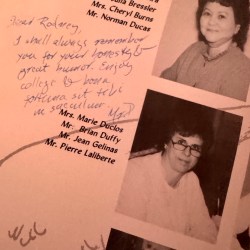
Recently, I found my old senior year book, and inside it he had written that he would always remember me for my honesty and my sense of humor. That line landed harder than it probably should have. He did not praise intelligence or achievement. He named qualities that suggested presence, risk, and a willingness to say what was true even when it was inconvenient.

Looking back now, I understand that what he really noticed was not an aptitude for Latin. He noticed a hunger for connection and a comfort with language as a living thing. He saw the possibility of a life built around words, meaning, and noticing, and he named it out loud. That naming mattered. There are moments when a teacher does not give you something new, but instead reflects something back to you that you had not yet trusted. Sometimes being seen is not about praise. Sometimes it is about recognition arriving early enough to change the shape of a life.

Thank you, Mr. Duffy.

February 2026
M T W T F S S
 1
2345678
9101112131415
16171819202122
232425262728