What The Middle Teaches: Notes From The Fringe – Day 9

Prompt –  A childhood game that taught you something about power.

P.E. sucked. Full on sucked. It was rarely fun. Inflatable projectiles flying across the gym, ropes that reached for the rafters, laps to check off a box for the that year’s President Physical Fitness Award, and knowing that teams had to be made with no assistance from the teacher. None of it was my cup of tea. But as a card carrying member of Generation X, I was metal-slide strong and did what needed to be done, even when it sucked.

On rainy days, the parachute came out in the gym. It always arrived like a promise. The teacher delivered a speech about cooperation and character while the smell of dust and sweat hung in the air. Sneakers squeaked on the gym floor, and the colors of the parachute glowed, promising community, but the sense of community never really followed. Still, we circled the parachute, fingers hooked around the edge, waiting.

Lift. Lower. Again.

The middle was different. The middle was the prize. One kid received the honor, always with quiet ceremony. The lucky kid would slip beneath and disappear into that cool, secret bubble of air while the rest of us kept the parachute alive.

Lift. Lower. Again.

Life on the fringe had a simple assignment. Pretend the work on the edge and the fun in the middle were the same thing. From the outside, it looked magical. From the edge, it felt like labor. Wrists burning. Shoulders tight. No glory. No cool air where it mattered. Still, hope lingered. Maybe next time the middle would belong to one of us. Maybe someone else would carry the weight.

I remember wanting the middle and fearing the middle at the very same time. Long before I understood language like power or systems, something quiet inside that circle told the truth. The kid in the center lived differently. The fabric rose for them without effort. Joy arrived without cost. Power gathered beneath the tent of color while the rest of us stayed at the fringe and pretended it was equal.

Life kept offering new parachutes after I left the gym…at home, in the classroom, and at work. The language was still teamwork. The reality was often a bright center that glowed while everyone else kept the rhythm steady. If I am honest, I have lived in both places. I have held the edge until my hands felt raw. I have also stood in the middle and felt how easily the circle can disappear from view.

The parachute taught a lesson I wish had waited until I was older. Joy is uneven. Work is invisible to those not doing it. And if you are not paying attention, you can live your whole life on the fringe, convincing yourself that the view is the same for all.

Now I pay attention. Who is chosen? Who is always lifting? When I find myself in the center, with air and space and room to move, I work to remember the circle. I notice the hands along the edge. I try to live as the kind of center that makes more room for everyone to breathe, and the kind of edge where collaboration is real.

January 2026
M T W T F S S
 1234
567891011
12131415161718
19202122232425
262728293031  

In the Margins, Where I Breathe – Day 7

Prompt – A rule you refused to follow.

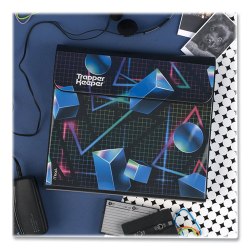
The cover of my Trapper Keeper glowed like the inside of an arcade, all neon and loud. “Stay Rad” splashed across the front like graffiti that wanted to be dangerous but felt more like a fat kid trying to be cool. Behind it, a glowing triangle pulsed like the screen right before a new video game loads. That brief pause held its breath and made a promise just like my planner. The Trapper Keeper whispered that anything was possible, if only life was structured in just the right way.

The lie it tried to sell me, and an entire generation, was simple. Stay organized and life will fall into place. Keep my schedules straight. Keep my notes tight. Keep my dreams in tidy sections, labeled, hole-punched, and snapped into place, class after class. If I could trap it, I could keep it.

There was a rule hidden inside that message, and I have bucked that rule since the moment I knew it existed. Use the planner and live by the calendar, treating the schedule like scripture, is what the academy says to be true. As a student and later as a teacher, I saw it everywhere, as common as desks and whiteboards. Another system. Another promise. Another planner with color-coded order pretending to tame the chaos. Such bullshit.

So I refused.

I refused the Franklin Planner. I refused the Full Focus planner. I refused the Roterrunner. I refused the PalmPilot because that thing never flew! I opened them. I turned the pages. I studied the boxes and printed times that tried to tell me where my life belonged, and something in me said no. I even carried some of them, like talismans I was expected to believe in. But schedules felt like cages. Those preprinted lines felt like a stranger beside me in the cafeteria, offering advice that did not know my story. I did not want every minute accounted for, nor did I want my thoughts sealed into plastic sleeves like tiny body bags for the dead.

Instead, I wanted space for the unexpected. I wanted room to scribble, cross out, wander, and return. I wanted the wide, blank page where anything might appear. Teachers said that being organized meant being mature. Colleagues said that being planned meant being professional. The rule insisted that if I could not live inside the planner, I would fall behind, lose track, and fail.

Maybe. Maybe not. Or absolutely not and immediately no.

What I knew, even then, was simple. My mind did not grow inside boxes. My imagination did not breathe inside time slots. The most important learning arrived in margins, in scribbles, in the slow wandering back to myself. I carried the Trapper Keeper and with it I carried the illusion of control. But the rule that said the planner must run my life. I refused that one.

And in refusing, I learned something I could not learn any other way. Life does not live on lined paper. Meaning does not arrive neatly labeled. The heart does not follow gridlines, and neither does grief, or wonder, or love, or anything that keeps me waking up and trying again. The planner promised certainty. What I needed was presence.

So I chose the blank space. The risk. The messy page that told the truth. Not tidy. Not perfect. Just alive. That became the real rule for me. Stay curious and be willing to get lost. What matters most cannot be trapped, and it sure as hell cannot be kept.

It can only be lived.

January 2026
M T W T F S S
 1234
567891011
12131415161718
19202122232425
262728293031  

Family Rules Silence – Day 6

Prompt – A rule you did not understand but followed anyway.

As a child, because I said so had a different flavor in my house. It showed up inside the command, Do what you are told, when you are told, and how you are told. I always wondered where the who and the why disappeared to in that little piece of military mantra nonsense. Every time I asked, the answer never arrived in words. It arrived through clenched teeth and lips pulled tight, the way a body looks when the mortician fucks up, followed by insults sharp enough to make my questions feel like crimes. The message was simple. Obey. And at the time, that is what I did.

Growing up under that rule taught lessons no curious child is meant to learn. I learned that questions were dangerous and not appropriate. I learned that curiosity was rude. I learned that authority did not need to make sense because authority owned the room. I began to shrink my voice. I memorized the script. I moved with a fixed response instead of a living person, at least inside the walls of my house.

Later, when I stepped into other systems as an adult, I recognized that same mantra living under different names. I saw it forcing its way into classrooms. I saw it showing up in workplaces built on top-down structures that pretended to be leadership. I saw it sitting quietly inside families that claimed love while everyone hid the truth. Do what you are told. When you are told. How you are told. It sounded efficient. It sounded orderly. It sounded like discipline. But beneath all of that shine, it trained me to doubt me and silence my own gut.

As a kid, I obeyed, even when nothing made sense. Obedience created quiet. It created peace, or at least the illusion of peace. But, like all things, there was a cost. What I believed to be obedience was actually just braided fear and respect until both looked the same. Obedience convinced me that the loudest voice in the room must also be the smartest. Obedience placed me inside someone else’s version of right and wrong.

I followed that rule because I believed it made me good. A good child. A good son. Much later, I began to notice the cracks. The whole thing felt like a performance. It was less about obedience and more about fear. Fear that if even one of us asked too many questions, the fragile idea of family might shatter and reveal what was already broken.

Real families ask questions. Real families sit in the discomfort of truth. Real families refuse to treat because I said so as a final answer. It took years for that realization to settle into my bones. My life’s work has become the practice of asking why, again and again, and creating spaces where others feel safe asking as well. And I am grateful to report that the world does not collapse when why is asked. The opposite happens. Everything begins to breathe.

January 2026
M T W T F S S
 1234
567891011
12131415161718
19202122232425
262728293031