Prompt: The First Time I Became Aware of My Body
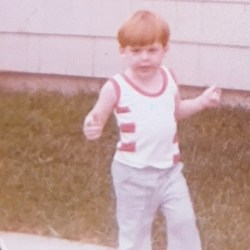
I was young, maybe three years old. Dates blur as much as addresses when life moves from base to base, so I cannot swear to the age. We had just moved again. New walls with new sounds. New shadows stretching across a room that did not yet belong. I woke in the middle of the night needing to take a leak. I do not remember the urgency itself, only the pattern; as a child, every trip to the bathroom felt like an emergency because children wait until the last possible moment.
I remember standing on cold, ugly linoleum and flipping the light switch on. The bathroom filled with that sudden brightness from the generic square fixture that lived in every room of base housing…wide, practical, square glass that never changed unlike the people in the house. I saw only the top of my head at first. Then I adjusted, lifted myself higher on the step stool, and there I was. A body. A somebody?
I talked to myself. Not in full sentences, just sounds and small words. I moved my mouth and my arms and watched them both follow my instructions. I turned sideways. I leaned closer to the mirror from the step stool. I remember feeling both surprised and completely certain at the same time. That was me. I could talk. I could move. I could do things. The awareness had nothing to do with my looks. It was about my agency. I was something inside this shape I was seeing in the mirror that obeyed me. It felt like discovering a toy I had always owned but had never played with until now.
Years later, a different type of body awareness arrived, and it was nothing like that first quiet moment in the mirror. The awareness did not come from me. It came from others. From glances that lingered too long. From jokes that sounded like laughter but felt like measurement. My body became something public before I understood it privately. I learned what I looked like through other people’s reactions long before I learned what I felt like inside my own skin.
At three, the mirror gave me independence with possibility. It was movement and voice in a body that could carry whatever story I wanted to tell. Later, the world handed me a different mirror. One that reduced me to my weight and size. One that suggested my body was something to manage, something to correct, something to explain. Both moments were awakenings.
What I know now, years later, is that neither version was the whole truth. The child in the bathroom mirror was right. The body was never a problem to solve. It was a place to live. A place to feel safe enough to grow, even when growth looked messy or uncomfortable or misunderstood.
Sometimes I think back to that kid standing in the bathroom, talking to himself like he had discovered a secret language. He did not yet know about weight or judgment or how easily a body becomes a story other people try to write for you. He only knew that he was there, awake inside his own reflection, testing what it meant to exist.
And maybe that is the first real awareness. Not the shape of the body, but the quiet recognition that someone is living inside it, watching, learning, waiting to decide which stories belong and which ones can be set down.
The mirror did not give me answers that night. It only gave me a beginning. And beginnings, I am learning, are often small, incandescent, and easy to miss until years later when the light finally makes sense.
| M | T | W | T | F | S | S |
|---|---|---|---|---|---|---|
| 1 | 2 | 3 | 4 | 5 | ||
| 6 | 7 | 8 | 9 | 10 | 11 | 12 |
| 13 | 14 | 15 | 16 | 17 | 18 | 19 |
| 20 | 21 | 22 | 23 | 24 | 25 | 26 |
| 27 | 28 | 29 | 30 | |||


 Muddled Soma