Borrowed Fire- Day 37

Prompt – A friend who pulled you toward trouble.

I have never had a true friend who pulled me toward trouble, but I did have a lot of trouble that pulled me toward people I called friends. In Plattsburgh, there was a kid who was more of a friend of a friend, or a friend of the group, a kid that drifted in and out of our orbit when he wanted. His name was Mike. He was short, quick to anger, and always looking for an edge to push. His dad was frequently gone on temporary assignments, and I never knew what his father’s job actually was. I only knew his absence hung in the air and created a lot of strain for Mike.

Mike’s height may have been part of his meanness, but the larger truth was that he lived inside a story that felt humiliating and painfully public. Even at thirteen, my group of friends knew what was happening at his house. Mike’s mother was finding her physical needs elsewhere when her husband was gone, and the worst part was not only that we knew, but that Mike knew we knew. That kind of knowledge does not sit quietly in a kid’s body. It turns into heat and rage. It turns into dare after dare. It turns into a need to control the narrative by burning it all down first.

Mike taught us all how to smoke. He taught us how to drink. We objectified women in magazines together in the South Side Trails. We were mean together. We keyed cars, put sugar in gas tanks, made prank calls, snuck into movies on base, shoplifted, and treated other people’s property like it was a joke we deserved to tell. When Mike was around, the meanness had a sharpness to it, like we were proving something. When he was not around, some of the same dumb choices still happened, but the cruelty did not have the same appetite. Mike did not just bring trouble with him. He brought a mood. He made all of us meaner than we were on our own.

The father situation was Mike’s issue, but it was also part of the wider tone on base. Plenty of fathers carried their own damage, and plenty of homes ran on alcohol, abuse, pornography, and the kind of quiet debauchery that never stayed as quiet as adults thought it did. Mike’s particular version of it was personal and specific. He believed someone else’s father was sleeping with his mother, and he believed everyone knew, and he lived inside that humiliation like it was a locked room he could not escape. So he pulled us down with him, and we went because we were young and because we were bored. We did not understand the difference between loyalty and participation. We were far too young to know how to pull someone up, and we were not yet brave enough to refuse the gravity.

Years later, I can see the shape of it more clearly. Trouble was never the point. Trouble was the language. Mike was trying to say, I am hurting, and I cannot stand being the only one who has to carry it. That does not excuse what we did, and it does not clean it up into something noble, but it does make the story more human.

What I hold now is this. I cannot go back and un-key the cars or un-make the cruelty, but I can tell the truth about how it happened. I can name the moment trouble stopped being thrilling and started being a warning. I can also be grateful that something in me eventually reached for a different kind of friend. Hope, I have learned, is not the denial of what I did or did not do. Hope is the decision to grow past it, and to recognize that pulling someone up sometimes starts with stepping out of the dark first.

February 2026
M T W T F S S
 1
2345678
9101112131415
16171819202122
232425262728  

The Grammar of Noticing – Day 23

Prompt – A teacher who noticed something in you.

Non solum oculis.

I took Latin in high school after taking French in junior high with an evil little man who had a bad comb-over, worse teeth, and no patience for ignorant little children messing up his language. I was absolutely not going to continue with French. So I switched to Latin. Latin was a dead language, at least on paper, but it turned out to be the most alive class I had ever taken.

What I learned in that room had very little to do with memorizing declensions and everything to do with how ideas are made. Mr. Duffy taught me that thinking is not a silent, private act that happens first and then gets dressed in words. Thinking is social before it is individual. Ideas are formed through interaction, through dialogue, and only later do those shared ways of thinking move inward, where they begin to feel private and personal. Language was not an afterthought. It was the place where thinking happened.

Mr. Duffy taught that language is not a box that holds ideas. Language allows ideas to form, collide, revise, and grow. Words do not simply name thoughts. They shape them. The structure of language influences what can be noticed, compared, questioned, and remembered. He showed us that expanding language, even by adding a so-called dead one, expands cognition. I did not have an academic understanding of all this then, but I understood it intuitively. He was right.

Because of Mr. Duffy, I became interested in languages and in what becomes possible when more than one linguistic system lives in the same mind. I learned that knowing more languages does not simply add vocabulary. It adds ways of organizing experience. Each language carries its own metaphors, its own logic, its own relationships between time, action, and responsibility. The more languages a person has access to, the more tools they have for connecting ideas, negotiating meaning, and making sense of the world with depth instead of speed.

Mr. Duffy noticed this curiosity about language in me before I did. He shared his thinking about language and life without making it feel like something that needed to be swallowed whole. He taught us Horace, the Roman poet made known by a new generation because of Dead Poets Society, and he used that film to draw us in and teach. He understood that attention is earned, not demanded.

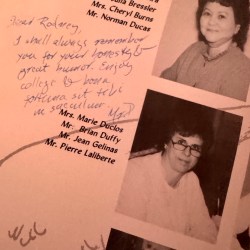
Recently, I found my old senior year book, and inside it he had written that he would always remember me for my honesty and my sense of humor. That line landed harder than it probably should have. He did not praise intelligence or achievement. He named qualities that suggested presence, risk, and a willingness to say what was true even when it was inconvenient.

Looking back now, I understand that what he really noticed was not an aptitude for Latin. He noticed a hunger for connection and a comfort with language as a living thing. He saw the possibility of a life built around words, meaning, and noticing, and he named it out loud. That naming mattered. There are moments when a teacher does not give you something new, but instead reflects something back to you that you had not yet trusted. Sometimes being seen is not about praise. Sometimes it is about recognition arriving early enough to change the shape of a life.

Thank you, Mr. Duffy.

February 2026
M T W T F S S
 1
2345678
9101112131415
16171819202122
232425262728  

Storms Outside, Stories Inside – Day 3

Prompt – A childhood place that made you feel safe.

Axl Rose sang about a warm, safe place where, as a child, he would hide and pray for the thunder and the rain to quietly pass. When I sang those lyrics, I kept circling that place in my mind, like walking past a house at night and wondering who lives there and what stories are inside. Where was it? What did it look like? Did it smell like rain, or like dust, or like a home that has been carrying histories longer than I had ever experienced. Was there room for another heart, or was it meant to be a solitary shelter? I also wondered why thunder and rain carried fear at all. Guns N’ Roses never revealed any detail about the space, but they hinted at a world without violent streets, without addiction, without love that wounds, and without that deep, rattling question of whether I deserve to exist here. They hinted at a place where the mind loosens, the body unclenches, and the soul finally exhales. A place that leans close and whispers that I matter. Everyone needs a space like that, especially in the years when the world grows louder than any child can tolerate.

My safe place was never a single room or secret hiding spot. My refuge arrived as words. School became the doorway, books the shelter, and language the quiet country I could travel without asking permission. Inside sentences, storms that belonged to me lost their teeth. Inside stories, I could breathe. I could sit with characters who carried their own griefs, their own bewilderment, and still somehow moved forward. In those pages, a different kind of safety revealed itself, not the kind that erases the world, but the kind that steadies a body long enough to survive it.

Nine schools before graduation. New towns. New faces. New rules about belonging. Again and again. The desks I occupied became the closest thing to permanence. The classroom did not care about orders, moving trucks, or how many times a heart could be asked to reset. Bulletin boards held more order and consistency than the houses I called home. School libraries felt like cathedrals, quiet and alive, each book humming with an invitation: Sit. Listen. Stay awhile. On air bases that never quite turned into home, the constants were teachers taking attendance, paper waiting for stories, and books wide enough to hold a kid who needed a place to land.

Over time, I learned something that felt almost sacred. Safety is not always locked behind a door. Sometimes it lives inside a paragraph, inside a voice on the page telling the truth without apology. Sometimes it lives in the discipline of showing up, sitting down, and letting language hold what feels too heavy to carry alone.

That was my warm, safe place. Not made of walls. Not built with wood or brick. My shelter came stitched together with words, strong enough to weather the thunder, patient enough to wait for the rain to pass, and honest enough to remind me that I matter, even when the world forgets to say it out loud.

February 2026
M T W T F S S
 1
2345678
9101112131415
16171819202122
232425262728  

East of Hoth – Day 2

Prompt – The first time you realized the world was bigger than your house.

Alaska is a large state. So large, in fact, that it pumps Alaskan egos up enough that people have created shirts with the outline of Texas carved out of Alaska with some smart-ass one liner bannered across the chest. For folks from Texas, this lands about as good as a well-done ribeye and a warm beer at a Sunday tent revival in west Texas.

Jeremy had lived his entire life on Randolph Air Force Base outside San Antonio. Same streets. Same house. Same bedroom. His father never had orders to move. Not once. Then, suddenly, they were ripped from south-central Texas along the San Antonio River and dropped at Elmendorf Air Force Base, somewhere just east of Hoth.

All this kid talked about was how bad Alaska sucked and how amazing Texas was. It was exhausting because I had no understanding of the words he spoke. I had never lived anywhere long enough to grow brand loyalty, root for the home team, or care two shits about the dump we were calling home that year. But Jeremy loved Texas. Fiercely. It was his. It was his home. And he reminded everyone that his home was better than this frozen hellhole.

Until Jeremy, I had never stood next to someone who had actually belonged to a place. The military does not usually allow that. On paper, the reasons sound noble. Rotations create experience. Rotations build leaders. Rotations prevent complacency. New base. New mission. New commander. Pack the boxes. Sign the forms. Start over.

But that is the polished version.

Underneath, constant movement serves the system more than the families inside it. When people stay rooted too long, they grow networks. They build equity. They find their own worth outside the rank on their shoulders. Roots create options. Options create questions. And questions slow obedience. So the military keeps the ground shifting.

Families never quite become local. The church is temporary. The school is temporary. The friendships are temporary. Even the dog feels temporary because the next base might be overseas and not allow pets. Moving trains the family to quietly to pack fast, detach sooner, and care, but not too deeply.

War needs people who will go where they are told and fight who they are told without needing to reconcile that decision with a neighborhood they have loved for twenty years. Do what your told, when your told, how your told! When you belong to the uniform more than you belong to the street you live on, it becomes simpler to leave. Simpler to fight. Simpler to lose and keep moving. Movement builds loyalty upward, not outward.

That was the world I lived in. So normal I could not see it. Then came Jeremy.

He had blown out candles at the same kitchen table for his third birthday, his fifth birthday, and his ninth birthday. He knew which tree in the yard was his climbing tree. He had a house that remembered him. Standing beside him on top of a mountain of snow pushed into the middle of the cul-de-sac while he mourned Texas like a lost Tauntaun, I felt something crack open. It was at that moment I knew the world was bigger than my house. And some people actually got to keep theirs.

February 2026
M T W T F S S
 1
2345678
9101112131415
16171819202122
232425262728  

Rot, Silence & Salt – Day 1

Inevitably, after the assignment had been described with as much intention and story as possible, after a small spark of curiosity has finally begun to glow in the room amongst the students, a hand goes up – Liam. Jesus Almighty! The question lands like cold water in the crotch.

How many words. How many pages.

In that moment, the invitation to think, to feel, to wrestle with something real collapses into a set of measurements. Not a conversation. Not discovery. Just requirements. Every. Damn. Time.

Discovery through writing has never been about word counts. It has never been about minimum or maximum lengths. Hell, it is not even about grammar, syntax, or the cleanest turn of a phrase. Writing is the practice of staying. Writing is remaining in the chair while the world keeps spinning, choosing to study whatever the last swirl left behind. No prescribed number of words will ever manufacture meaning in a soul unwilling to face what hurts long enough to understand it.

Writing is salt in the wound. It burns. It draws out what has been hiding. The good. The bad. The unspeakable. It makes the environment less friendly for the slow rot of memory and the quiet infection of trauma. The work is to sift through the mess and keep asking the questions that insist on being asked. What happened? How did it unfold? Where did it mark the body, the heart, the mind? Who stood inside that moment, and how might I be slowly forming because of it.

The work is not pretty. The work is excavation. Writing is digging through memory, through failure, through rage, through grief, and asking questions that do not care about comfort nor wish to answer the question of  who left the scar or cut the bone.

Sometimes the words slam the door on repetition. Sometimes repetition of the same word is the only victory. A thin, trembling layer of a word laid across chaos to create order just long enough to hear a whisper calling from underneath the shit. No healing. No closure. Just enough clarity to understand a moment or a thousand without continuing to lie it is all going to be okay.

Sometimes the words keeps the moment from returning. Sometimes the words reveal that the moment will return again and again. But sometimes this means 200 words on the back of scratch paper, other times it means two years of journaling daily. Pages cannot measure that. Word counts cannot measure that. This is not the filling of space. This is the uncovering of something quieter, something that only surfaces when a I stay long enough for the truth to step forward.

And the part my students never could stomach and took me years to learn. The words and the story will not fix the past, repair the fracture, or reconcile anything that has been lost. The story simply refuses to look away like some fucked up carnival mirror bearing witness to the pain just to know it happened. There is a violence in that kind of honesty. A necessary violence. A ripping away of the polite fabric that keeps everyone smiling while they bleed out of sight. Writing does not draw the curtain, rather it pulls it down and throws it on the floor and forces the scene to stand there naked in the dark. And write enough, and a candle may be lit to see there needs to be more work done!  Because the page keeps its own ledger. The page knows when it is lied to. The page knows when the writer flinched and pulled back and dressed the truth up to make it digestible. The page waits. The page holds the line until the writer returns with something real enough to remove the fig leaves and know this is holy ground.

And so, Liam, I cannot tell you how many words it will require. I can tell you that if you do not write the alternative is rot. The alternative is silence, and silence is where the worst lies grow strong. Writing is the refusal to feed them. That is the assignment. That is the cost. That is the only way any of it matters.

But, let’s start with 500 words. Daily. Prompt in hand. And try to make a connection after every month and theme. Sound good?

February 2026
M T W T F S S
 1
2345678
9101112131415
16171819202122
232425262728