One Street Over – Day 33

Prompt – How did the friendship start?

For those who want the beginning context for today’s prompt, the first post about Jeremy can be found here.

My first real best friend was Jeremy. He was a Texan through and through, transplanted abruptly to Alaska. The shock showed on him, as this was his first military PCS ever. I arrived from California, where my family left March Air Force Base because of an incident I have only ever heard in fragments. The whole truth never mattered as we would have eventually left anyway. I had just finished second grade and knew almost nothing except that something had ended and something else had begun without my consent.

The drive up the ALCAN highway was relentless. When my family finally reached Elmendorf Air Force Base, there was no housing assignment waiting for us. We were placed in temporary living quarters for far too long. After weeks on the road with my family, traveling a half-paved road a thousand miles long in a U-Haul, the TLQ did not feel like home. The place felt heavy in ways I had never experienced before. And it got weird.

Colors in the TLQ would thin and deepen without warning, where color should have remained constant. Corners stayed cool while the center of rooms held warmth. The hallway carried a faint blue cast that no one else seemed to notice. Temperature changes brought memories with them. Grief lingered as anger did too. There were people there as well, not figures meant to frighten, but impressions. More like presences. I did not see them with my eyes alone. I felt them with my body. That kind of noticing is exhausting, especially for a child. I needed someone to help me carry it.

Jeremy showed up.

Beginnings and endings rarely announce themselves. They arrive disguised as coincidence or as a kid who happens to live one street over. At the time, it felt like luck. Looking back, it is clear that something essential was taking shape, something the universe wanted me to notice.

He had never moved before. Not once. His entire life had existed in one state until it did not. He was burdened with the newness of goodbyes and hellos. I was practiced in leaving. Somehow that made us fit, as we each had something to carry for the other.

That friendship did not begin because we were alike or because we chose one another with intention. It began because two children were standing inside unfamiliar spaces, each holding more than was reasonable for their age. Something in him recognized something in me, and the recognition was mutual.

I understand now that this is often how early friendships form. Not around joy, but around need. Around the quiet relief of not being alone with what is not yet understood. Long before we know how to tell our stories, we sense who might be able to hear them. That was the beginning. Not a single moment, but a shared breath, an inhale and exhale taken together, a small and steady proof that even in unfamiliar places, connection finds a way to form.

February 2026
M T W T F S S
 1
2345678
9101112131415
16171819202122
232425262728  

The Accounting of the Siblings – Day 30 & 31

Prompt (2) – Being chosen. Being ignored.

Home of the Highlanders, MacArthur High School was the clearest definition of an oxymoron I had encountered up to that point in my life. Highlanders in the Great Plains with a motto of “People First, Excellence Always” in a transient town better known for pawn shops and titty bars…Jesus Almighty! The contradiction was not subtle in the least.

When I arrived, I was immediately chosen. I was chosen not for anything I had done or earned, but for the size of my body. I am certain the coach believed he was offering affirmation, maybe even opportunity. He likely told himself a story about coaching me up and bringing discipline that would later open doors. What he actually did was place around my neck a weight that lasted the entire year, and much longer if I am honest. His choice was not about me. It was a projection of how I could be useful to him and his team. Utility masquerading as care has a particular heaviness to it. It presses down slowly on a proud chest and insists on gratitude while doing so.

I would have preferred to be ignored rather than bullied for an entire year for refusing his offer. That refusal marked me. It made me a problem instead of a resource in that space. Being ignored, however, also carries its own kind of damage. It teaches a collective disappearance as a survival strategy. It rewards silence and compliance and requires no accounting.

Being chosen and being ignored feel like opposites on paper, but they share the same origin story. They are siblings of a parental unit with an “idea of parental compassion is just, you know, wacko!” Both being ignored or chosen single a person out. Both carry judgment. Both demand something without ever asking who someone is.

In school, I was chosen in ways I never requested, and I was ignored in ways I did not deserve. From lessons I learned at home, I tried to stay small and as invisible as possible, yet chosen for a task I was not prepared to bear. Staying small felt safer than being evaluated. Invisibility felt preferable to becoming a symbol or a cautionary tale. I wanted neither attention nor erasure. That tension followed me for years. Over time, that same tension gave me eyes to see it later. It taught me how to notice patterns and to recognize when power was pretending to be neutral. It also pushed me to try to name what I was seeing, first quietly, then more openly, even when doing so came at a cost.

The cult classic movie The Breakfast Club offers one of the clearest examples of these siblings with a shared back story that I know. It is a film I used in class for years as an educator, not because it is perfect, but because it is honest about hierarchy and the siblings. John Bender, labeled the “criminal,” delivers a line to the “princess,” Claire, that sounds cheeky but is filled with lived experience. He says, “You could not ignore me if you tried, sweets.” It lands as swagger, but the truth inside it is heavy. John Bender knows exactly where he stands. The popular kids can pretend he does not matter, but they cannot erase him from the room. He takes up space in that place because disappearing has already been assigned to him elsewhere.

Bender is not chosen. He is tolerated by those who are there. He is watched. He is remembered only as a problem. The popular kids do not forget him because he is insignificant. Forgetting him allows them to keep their version of themselves intact. Remembering him would require reckoning. I recognized that math immediately! I learned early how to make myself unignorable without ever being chosen. There is a difference. Being seen is not the same as being held. Being loud is not the same as being safe. Like Bender, I understood that if I did not exert some control over my visibility, someone else would decide whether I vanished or became a spectacle.

Bender’s anger is never random. It is precise. It is armor. It is a refusal to disappear quietly for people who benefit from not having to see him. Later in the movie, he says what has been true all along. “What do you care what I think, anyway? I do not even count. I could disappear forever and it would not make any difference. I may as well not even exist at this school.” That is not defiance. It is once again accounting. He understands the math of the place better than anyone else in the room.

Claire believes she counts so much that her absence would register as a crisis. However, John’s absence would register as relief. He is visible enough to be punished and invisible enough to be disposable. That is the difference he names when he turns on her. It is not cruelty. It is clarity. He is not asking to be liked. He is asking to be recognized as existing and to be seen as worthy.

That scene stayed with me because I could relate to each of the siblings leaving the same residue.

What I learned much later is that choosing myself had to come before anyone else did. Not loudly. Not as performance. Not as rebuttal. Just steadily and quietly. Choosing myself meant staying present without auditioning. It meant letting some rooms misunderstand me, letting some people leave, and sometimes me leaving the room. It meant trusting that I was worthy. There is a particular peace that comes with no longer arguing with the ledger. I no longer need to prove that I count. I do not need to disappear to survive or accept a role that requires self-erasure to belong. That choice does not erase the past, but it does loosen the siblings grip on me. The brothers can continue their work elsewhere. I have already chosen a different inheritance.

February 2026
M T W T F S S
 1
2345678
9101112131415
16171819202122
232425262728  

Husky Jean Calculus- Day 28

Prompt – Trying to fit in.

Growing up, we never had enough money for the things everyone wanted. Back-to-school shopping was always tense because school supplies and clothes were expensive, and the margin was thin on a good month. My older siblings were teenagers, which meant shoes and clothes mattered in the unspoken social calculus of school. My mother, meanwhile, was running a different set of numbers, the kind tied to groceries, bills to be paid, and the quiet reality of coming up short and it all being her fault.

One afternoon in a store, my mother’s shoulders were tight as her attention was divided between price tags and possibility. She was doing the math in her head, calculations that did not resolve cleanly. I noticed, as I always noticed because I was old enough to see but I was far too young to understand what it actually was I was seeing.

So I erased myself. I said I would take whatever was cheapest. If it meant the not-cool clothes, that was fine or the cheaper Rose Art crayons, so be it. I said it lightly, as if it cost nothing, but I knew those words gave my mother a moment to breathe as I gasped for air. It was not that I wanted my siblings to have the best as I became a martyr, rather, I wanted peace in the house. Peace meant freedom from tension, freedom from eggshells. So I chose less and I told my eleven-year-old self that this is what being good looked like.

As I got older, I wanted to fit in everywhere. I wanted to fit in at home, at school, and inside my own skin. I wanted all of it without understanding that wanting everything at once comes with a cost. Somewhere along the way, I became exhausted, as my energy was limited. Survival required efficiency and a lot of energy.

I stopped caring about fitting in at school. Or at least I learned how to perform not caring about fitting in at school. This was not bravery. It was conservation. I redirected what little I had toward staying upright, toward “reading the room”, and toward becoming agreeable and invisible in equal measure. Endurance became my defining trait. I mistook it for identity and called it a personality.

The truth arrived later, quietly, the way truth tends to. I wanted to fit in, but what I really wanted was to belong. Belonging did not ask for performance. It did not require erasure to keep others comfortable. It allowed me to stay. I never had that in my first family.

Fitting in changes a person to earn acceptance. Belonging offers acceptance without negotiation. Fitting in hides real opinions. Belonging makes room for honesty with care. Fitting in depletes. Belonging restores. Fitting in is about how things appear. Belonging is about how things hold throughout the years.

I did not know any of this then. I only knew how to choose peace over cool, quiet over attention, and survival over style. The meaning of those choices took years to surface. Looking back now I see my erasure was not tenderness…it was twisted. But now, I finally belong and there is finally room for me to remain.

February 2026
M T W T F S S
 1
2345678
9101112131415
16171819202122
232425262728  

Square Pizza & Neutral Ground – Day 27

Prompt – Lunchroom politics

Through the fifth grade, the lunchroom was neutral ground. It required only a basic understanding of a single-file line, eighty-five cents, and the know-how to choose wisely from the menu. The homemade square pizza made by Carol the Lunch Lady reigned supreme, folding in half but never breaking thanks to a level of grease that functioned as both flavor and structural support. The sloppy joe, held together by far more ketchup than beef, tested gravity and came in a respectable second, especially when paired with tater tots that counted as a vegetable because everyone agreed to pretend they were potatoes. Then there was the taco, which had never heard Spanish and knew no spice at all. Finished off with a carton of chocolate milk and the meal was complete. That was it. No strategy was required, nor was any understanding of complex human hierarchical structures necessary. The menu told everything that needed to be known.

Sixth grade changed the terms. The lunchroom acquired borders much like invisible fences that everyone pretended not to see while obeying their “Posted” notices perfectly. Rules appeared, not published ones, but learned ones. Seats were no longer neutral. Placement mattered, and choice was often an illusion, as belonging did the choosing long before anyone sat down. Jocks clustered loud and confident, already rehearsing for futures that assumed space. Band kids gathered with instrument cases leaned against their legs like shields. Nerds formed tight constellations around shared intelligence and inside jokes. Religious kids bowed their heads before eating, not so much for God as for each other. Floaters drifted from table to table, fluent in small talk and practiced exits. Loners learned how to sit with a book and make it look intentional.

The food did not change. The square pizza never left. What changed was the audience and, with it, the purpose. Lunch became a daily referendum on who was permitted to be seen together and who was better off unseen. Seats mattered. Laughter mattered more, because laughter signaled togetherness and safety. Silence could be read as arrogance or fear, depending on who was watching and what they needed it to mean that day. Some seats had to be earned, while others came with unspoken warnings to stay away. The politics were efficient and selectively cruel, enforced mostly through looks, although words were occasionally deployed when looks failed.

The lunchroom became my first real lesson in social cartography, a place that taught where power sat and where safety might be found if one looked closely enough. What I did not understand then was that everyone else was learning the same lesson at the same time, each of us convinced of being the only one studying the map so desperately. The tables felt permanent, the labels felt fixed, and the consequences felt endless.

Looking back now, the comedy of it all lands harder than the fear ever did. Grease-soaked pizza and ketchup-heavy sloppy joes were never really the point. The lunchroom was a training ground, rehearsing adult versions of conference rooms, waiting rooms, and dinner tables where the same invisible fences still exist. The difference is that, with time, the map becomes easier to read, and the borders begin to look less international and more domestic. That realization does not erase the lesson, but it does soften it, allowing the memory to sit where it belongs, alongside the chocolate milk and the understanding that belonging was always more fragile, and more negotiable, than it first appeared.

February 2026
M T W T F S S
 1
2345678
9101112131415
16171819202122
232425262728  

Typecast – Day 24

Prompt – A teacher who misunderstood you.

Some misunderstandings arrive loudly. Others settle in quietly and take up residence for a year.

I have always hated sports, especially the kinds tethered to institutions that claim to build character while quietly reinforcing outdated power systems. Organized athletics, particularly in schools, often function as rehearsals for outdated hierarchal power structures where bodies are ranked, obedience is rewarded, and aggression is sanctified. It is an impressive trick, really, dressing control up as virtue and calling it tradition.

The move from Plattsburgh, New York to Lawton, Oklahoma happened without ceremony. My father retired and received his ceremony, but the rest of us got Lawton. Plattsburgh had been a place of friendships, small freedoms, and the early shaping of who I thought I might become. Lawton felt like the opposite of aspiration. It sat flat and exposed, surrounded by land that did not soften itself for anyone. The Wichita Mountains loomed nearby, ancient and tired, as if they were retires and had already delivered their lessons and were content to watch the rest unfold without comment.

Everything about Lawton felt temporary. Fort Sill, an Army installation, fed it and drained it in the same breath. People arrived. People left. The town understood itself as a stopover, and that knowledge seeped into its schools, its rhythms, its expectations.

I arrived at MacArthur High School for tenth grade already out of place. I came from upstate New York into a culture where teenagers watched CMT, drove lifted trucks, wore boots like uniforms, and treated football as a civic religion. The worship of the pigskin was not casual. It was culture and religion.

At orientation, I went to pick up my schedule and tour the school. A coach saw me before anyone else did. He did not ask my name. He did not ask what I liked, what I read, or what I had already learned to survive. He saw my size and filled in the rest of the story himself. In his mind, I was already useful.

He wanted me on the field, blocking for a quarterback whose future everyone already knew would peak early and flatten out into something like selling roofs. The coach spoke with certainty, the way people do when they believe their imagination outranks your agency. He framed it as opportunity. He framed it as belonging. What he meant was ownership.

Why would I not want this, he assumed. Why would a body like mine not belong to him.

For weeks, he pursued me in the hallways with passing comments and encouragement that felt far more like pressure. Compliments came preloaded with expectations. Interest came with conditions. When it finally became clear that I cared far more about books than drills, words than whistles, his attention shifted. Not away. Sideways.

He did not apologize for misreading me. He did not correct himself. He simply adjusted the narrative so that my refusal became a flaw instead of a choice.

He spoke to his team.

For the next year, I was punished for refusing a role I had never auditioned for. The same boys who sat in church pews on Sunday spent the week reminding me that difference was not tolerated and would be corrected through cruelty. They bullied with the confidence of the absolved. It was cruelty wrapped in ritual, consequence-free and self-righteous. Repentance on Sunday. Retribution on Monday. A very efficient system.

What hurt most was not the bullying itself. It was the loss of sanctuary. School had always been the place where I could breathe, where the chaos of my family receded into the background. That year, even school became unsafe. The teacher who misunderstood me did not see that he had taken more than a season from me. He took the one place where I had believed misunderstanding might be corrected through learning.

Years later, I understand that his failure was not personal. It was structural. He was trained to see bodies as tools, not stories. He mistook size for allegiance, silence for agreement, and refusal for betrayal. He never learned to ask who a student was before deciding what they were for.

I learned something else entirely. Refusing a script can cost comfort. Teachers, when they misunderstand, can leave marks as lasting as those left by the ones who see you clearly. And some confuse authority with insight and never notice the difference.

Some misunderstandings pass. Others teach you exactly how carefully you will guard your interior life from that day forward. Hut Hut Hike!

February 2026
M T W T F S S
 1
2345678
9101112131415
16171819202122
232425262728  

All the Ingredients, Yet No Meal – Day 21

Prompt – What dinner time taught you about belonging.

Dinner was never about the table in my house. We rarely gathered around a full place setting of dishes spread around the table. By the time my siblings were gone and I had reached my formative years, the chairs stayed pushed in and unused, as if they were props from a different version of life. The table was not for meals, conversations, homework, or family meetings in my house. The table, like the house itself, was quiet, and quiet was something my family wore well.

The kitchen, however, told a different story.

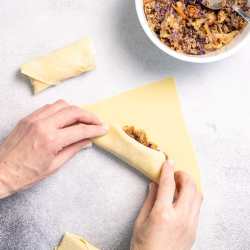
Cooking was where my mother spoke, at least with me. She talked while her hands worked, as if movement unlocked language that stillness could not. She told stories while we rolled egg rolls together, her fingers moving with confidence and memory. While her chili simmered, she explained things that were never addressed directly, lessons tucked into technique and timing. She talked while I grated potatoes for breakfast, the raw metallic sound of the grater filling the room with a steady, unforgiving rhythm. That sound still lives in my memory, carrying both comfort and sadness in equal measure.

Those moments were where belonging happened because those moments were where actual communication briefly lived. I heard history while standing at the counter. She talked about Papa, her father, owning a restaurant and a bakery, and about growing up inside that world of work, responsibility, and food. She talked about my siblings when they were younger, sharing stories from before I arrived, memories I inherited without ever living. I learned who they were through her voice and through the rhythm of her hands as she cooked from memory. I learned where I might fit by listening carefully to places where I had not been.

I was allowed and encouraged to help. I added ingredients. I stirred pots. I rolled wrappers. I watched closely. Participation was welcomed in pieces, but the whole recipe of family was never quite assembled. We could gather parts and play our roles, but the finished pie never made it to the table.

That became the pattern.

Belonging, for me, was never about sitting down together. It was about proximity and presence. It was about standing nearby, being useful without being central, and being present without being required. Love arrived in fragments, measured in shared tasks and quiet moments in the kitchen. I learned that connection did not always look like unity. Sometimes it looked like parallel movement within the same small space.

Dinner taught me that families can function without ceremony and that care can exist without coordination. It taught me how to listen while working, how to receive stories instead of affection, and how to recognize that some people only know how to give when their hands are busy.

Even now, kitchens feel safer than tables. I trust the hum of preparation more than the stillness of unspoken expectation. And maybe that is not a flaw, but a beginning. Maybe belonging does not always ask us to sit down and face one another. Sometimes it simply asks us to stay close enough to hear the stories while something nourishing is still being made.

February 2026
M T W T F S S
 1
2345678
9101112131415
16171819202122
232425262728  

Head, Shoulders, Arms, & Toes – Day 19

Prompt – What is something you inherited that is invisible.

Meeting new people is routine for me as an educator. Conferences, professional development sessions, even the pedagogy aisle of a bookstore invite brief conversations with strangers. If the talk lasts long enough, the question of where I am from eventually appears. My answer lands in an awkward nowhere. There is no single city or state to name. I follow it with military brat, and more often than not, the response is me too.

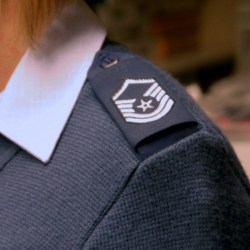
That is usually all it takes. From that short exchange, I can place them – NCO kid or officer kid. The distinction is not always visible, but it is all too familiar. For those that do not speak military, NCO stands for noncommissioned officer, while officers hold formal commissions granting authority to lead and command. In plain terms, NCOs resemble blue collar middle managers, while officers mirror executive leadership. The stereotypes of each military group carry over from the groups in civilian life all too well. I recognize the difference not because I am trying to sort people, but because I learned to read hierarchy long before I understood its cost.

As the conversation continues, my eyes drift where they always do. Look at the shoulders. Look at the arms. Look at the posture. I look for rank even when it is no longer stitched into fabric. Power announces itself quietly, through who stands at ease and who remains alert, through who speaks freely and who measures every word. Authority does not require a uniform. It lives in tone, in social standing, and in permission.

I carried that awareness out of childhood and into adulthood, from military structure to religious hierarchy to professional systems. Each one promised order. Each one insisted it was different. The symbols changed, but the sorting remained. Stripes became titles. Doctrine became policy. Obedience learned new language. What made each system dangerous was its invisibility. Power no longer lived on sleeves. It lived in access, approval, and exclusion.

I thought I was adapting. I thought I was growing. I did not realize I was just learning new ways to disappear to survive. By the time I saw it clearly, it had already shaped me. The reflex stayed. Even now, I scan for hierarchy, not because I want to participate in it, but because I know how quickly it hardens and who it leaves behind.

Throwing it off was not dramatic. It was an internal unlearning. A refusal to confuse structure with safety or authority with worth. I no longer measure myself by proximity to power. I measure myself by who I stand next to when belonging is being decided.

What I carry is invisible and indeed inherited from growing up in a military family, but it continues to show up whenever authority appears and decides who belongs and who does not. It keeps me honest. It keeps me watchful. It reminds me that seeing exclusion is already a kind of resistance. And now, I always make sure to stand with the other, if for no reason to make sure they do not feel alone – me as well!

February 2026
M T W T F S S
 1
2345678
9101112131415
16171819202122
232425262728  

Fine, and Other Lies We Learned – Day 14

Prompt – What was a secret your family carried?

Pink Floyd, Van Halen, Skid Row, Meat Loaf, U2, Ozzy Osbourne, and even Barry Manilow gave me heart and gave me a language I could own. Their songs taught me how to feel without apology and how to sit with emotion long before I had the words, the permission, or the safety to do so. Music became my private tutor. However, that education came at a cost.

At fifty-one, my ears feel at least twenty years older than the rest of me because concerts were never simply live shows. They were full-body immersion experiences built from stacked speakers, vibrating floors, and sound loud enough to register as belonging, even for the most awkward of us packed into the crowd. Like most people my age, I never protected my hearing because it never occurred to me that I was borrowing against something future me would need to navigate ordinary life.

Now conversations require intention and precision. If someone does not speak clearly, with attention to tone, volume, and rhythm, the words scatter before they reach me, and I find myself asking for repetition or filling the silence with a reflexive huh. I miss parts of sentences and occasionally whole meanings, and whispers are simply not accessible to me anymore. Still, I carry no regret because losing the ability to hear whispers forced me to notice something I had been living with all along.

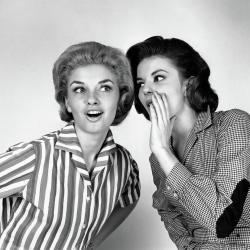
Whispers had always been part of my life, long before the music ever stole them from me. Whispers and mumbled speech were the true secret my family carried, not one dramatic confession or a single locked drawer hiding a headline-worthy truth, but something far quieter and far more durable. The secret was cumulative, made of a thousand small omissions, a thousand almosts, and a thousand things that were never named but were felt every single day.

The secret lived in the spaces between words. It lived in dinners where everyone ate but no one spoke about what hurt. It lived in rules enforced without explanation and affection that arrived sideways through duty. It lived in silence that passed for peace and order that pretended to be safety. Nothing was hidden exactly. Everything was simply unattended.

Each person in my family carried their own version of the unspoken. Grief without language. Anger without permission. Fear disguised as discipline. We learned to move around one another carefully, like furniture in a dark room, memorizing where not to step. Over time, caution became habit, and habit hardened into our culture.

Those secrets were never malicious, at least not at first. They were inherited. They were learned through the belief that survival mattered more than honesty, that stability mattered more than intimacy, and that asking for help meant failure. The secrets survived because they felt normal, because they never announced themselves, and because they whispered. That was the most dangerous part. No one ever learned how to hear them.

No one named the absence. No one said that something essential was missing. We were fed, housed, dressed, and moved efficiently from place to place. On paper, we were fine. The secret hid inside that word until fine became the highest achievement and the finish line. I grew up believing that families simply endured one another, that love was proven by staying rather than speaking, that conflict was something to avoid rather than move through, and that feelings were personal inconveniences best handled alone. I did not know these were beliefs. I thought they were facts.

When the secret finally revealed itself, it did not arrive as scandal, but as grief. Grief for what none of us were taught. Grief for the conversations that never happened. Grief for the care that wanted to exist but never learned how to speak. Our secret was grief.

February 2026
M T W T F S S
 1
2345678
9101112131415
16171819202122
232425262728