Prompt – A friend who helped you see yourself more clearly.
Lots of firsts happen in high school. Some turn into great stories, while others stay quiet and make a person better without fanfare at all. Carol was one of those quiet firsts for me. She was a minor character in my storyline, but she helped me see myself more clearly and understand that I was a process inside a process.
We found each other in Ms. Peregrine’s art class, and then we kept finding each other outside of it. We went to coffee shops and talked the way early 90s kids talked when we thought the world might be ending and might also be remade in the same week. Our conversations had that grunge, almost avant garde seriousness that made everything feel both ridiculous and sacred. Music was always part of it because music was how we translated ourselves back then. The Smiths, The Psychedelic Furs, Nirvana, it all gave us language when we did not have enough of our own.
Carol drove an old Saab, and we would head out to Derry, New Hampshire, to a small coffee shop where time slowed down. For a while, life really did seem simple: coffee, cigarettes in the cold air outside, art talk, future talk, and the illusion that we could choose our next chapter without the past reaching up to claim us.
Right before graduation, we went for coffee the way we usually did, and I told her about the next move, the one that was supposed to mean freedom. College. It was another fresh start with another address, but this one would be mine. It was still another version of me being packed up and carried forward, but it was going to be away from them. Carol listened, then reached down and handed me a gift. It was a vase she had made.
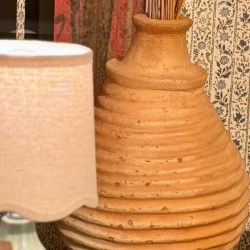
It still sits in my house. Like me, it is not smooth. It is textured, marked by the touch of others, and it does not pretend to be untouched. Its surface is made of rings, each one visible, each one earned. I can see where the clay was pressed thinner, where it was pulled upward, where it almost failed and did not. The shape narrows, widens, and narrows again, and nothing about it feels accidental. It looks like a thing that has been worked. It looks like a thing that has been tested. It looks honest.
When Carol handed it to me, she did not talk about the beauty of the object. She talked about the process. She told me that each move, each experience, each hurt, each whatever, reduces us. The wheel pulls the clay down even as it spins it forward. Loss compresses and change thins because living costs something. But then, she said, another hand builds us back up. Another layer with another pass, and another choice. She spoke like she was offering a map, and I remember realizing she was not just talking about clay. She was talking about me, and she was doing it in a way that did not feel like pity. It felt like recognition.
What stays with me is the part that sounded almost too simple to be true. The height is not predetermined. The clay does not decide that. The wheel does not decide that. The hands do. I do.
That sentence landed in a place in me that had always assumed the opposite. I had lived as if the moves and endings and misunderstandings were the authors, as if the next chapter was always something that happened to me rather than something I shaped. I had learned how to adapt, how to read rooms, how to disappear when necessary, and how to be grateful for whatever remained. I had not learned how to claim the idea that I could still choose. Not in the shiny motivational way, but in the real way, the slow way, the hands on the wheel way.
Experience is experience. It is not good or bad in the clean moral categories people love to use to make life feel organized. It is formative. It shapes. The vase does not judge the pressure that made it narrower. It holds it. It carries it forward. The narrow places make the wider ones possible. The evidence of strain becomes part of the strength, not an argument against it.
Carol helped me see myself more clearly. She gave me an image that could hold complexity without turning it into judgment. She handed me a physical reminder that being shaped is not the same thing as being broken.
The vase sits there, quiet and unimpressed, holding its own history without apology. It reminds me that I can honor what shaped me without letting it name my limits. The clay remembers everything. And still, it holds.
| M | T | W | T | F | S | S |
|---|---|---|---|---|---|---|
| 1 | 2 | 3 | 4 | 5 | ||
| 6 | 7 | 8 | 9 | 10 | 11 | 12 |
| 13 | 14 | 15 | 16 | 17 | 18 | 19 |
| 20 | 21 | 22 | 23 | 24 | 25 | 26 |
| 27 | 28 | 29 | 30 | |||

 Muddled Soma