The Accounting of the Siblings – Day 30 & 31

Prompt (2) – Being chosen. Being ignored.

Home of the Highlanders, MacArthur High School was the clearest definition of an oxymoron I had encountered up to that point in my life. Highlanders in the Great Plains with a motto of “People First, Excellence Always” in a transient town better known for pawn shops and titty bars…Jesus Almighty! The contradiction was not subtle in the least.

When I arrived, I was immediately chosen. I was chosen not for anything I had done or earned, but for the size of my body. I am certain the coach believed he was offering affirmation, maybe even opportunity. He likely told himself a story about coaching me up and bringing discipline that would later open doors. What he actually did was place around my neck a weight that lasted the entire year, and much longer if I am honest. His choice was not about me. It was a projection of how I could be useful to him and his team. Utility masquerading as care has a particular heaviness to it. It presses down slowly on a proud chest and insists on gratitude while doing so.

I would have preferred to be ignored rather than bullied for an entire year for refusing his offer. That refusal marked me. It made me a problem instead of a resource in that space. Being ignored, however, also carries its own kind of damage. It teaches a collective disappearance as a survival strategy. It rewards silence and compliance and requires no accounting.

Being chosen and being ignored feel like opposites on paper, but they share the same origin story. They are siblings of a parental unit with an “idea of parental compassion is just, you know, wacko!” Both being ignored or chosen single a person out. Both carry judgment. Both demand something without ever asking who someone is.

In school, I was chosen in ways I never requested, and I was ignored in ways I did not deserve. From lessons I learned at home, I tried to stay small and as invisible as possible, yet chosen for a task I was not prepared to bear. Staying small felt safer than being evaluated. Invisibility felt preferable to becoming a symbol or a cautionary tale. I wanted neither attention nor erasure. That tension followed me for years. Over time, that same tension gave me eyes to see it later. It taught me how to notice patterns and to recognize when power was pretending to be neutral. It also pushed me to try to name what I was seeing, first quietly, then more openly, even when doing so came at a cost.

The cult classic movie The Breakfast Club offers one of the clearest examples of these siblings with a shared back story that I know. It is a film I used in class for years as an educator, not because it is perfect, but because it is honest about hierarchy and the siblings. John Bender, labeled the “criminal,” delivers a line to the “princess,” Claire, that sounds cheeky but is filled with lived experience. He says, “You could not ignore me if you tried, sweets.” It lands as swagger, but the truth inside it is heavy. John Bender knows exactly where he stands. The popular kids can pretend he does not matter, but they cannot erase him from the room. He takes up space in that place because disappearing has already been assigned to him elsewhere.

Bender is not chosen. He is tolerated by those who are there. He is watched. He is remembered only as a problem. The popular kids do not forget him because he is insignificant. Forgetting him allows them to keep their version of themselves intact. Remembering him would require reckoning. I recognized that math immediately! I learned early how to make myself unignorable without ever being chosen. There is a difference. Being seen is not the same as being held. Being loud is not the same as being safe. Like Bender, I understood that if I did not exert some control over my visibility, someone else would decide whether I vanished or became a spectacle.

Bender’s anger is never random. It is precise. It is armor. It is a refusal to disappear quietly for people who benefit from not having to see him. Later in the movie, he says what has been true all along. “What do you care what I think, anyway? I do not even count. I could disappear forever and it would not make any difference. I may as well not even exist at this school.” That is not defiance. It is once again accounting. He understands the math of the place better than anyone else in the room.

Claire believes she counts so much that her absence would register as a crisis. However, John’s absence would register as relief. He is visible enough to be punished and invisible enough to be disposable. That is the difference he names when he turns on her. It is not cruelty. It is clarity. He is not asking to be liked. He is asking to be recognized as existing and to be seen as worthy.

That scene stayed with me because I could relate to each of the siblings leaving the same residue.

What I learned much later is that choosing myself had to come before anyone else did. Not loudly. Not as performance. Not as rebuttal. Just steadily and quietly. Choosing myself meant staying present without auditioning. It meant letting some rooms misunderstand me, letting some people leave, and sometimes me leaving the room. It meant trusting that I was worthy. There is a particular peace that comes with no longer arguing with the ledger. I no longer need to prove that I count. I do not need to disappear to survive or accept a role that requires self-erasure to belong. That choice does not erase the past, but it does loosen the siblings grip on me. The brothers can continue their work elsewhere. I have already chosen a different inheritance.

February 2026
M T W T F S S
 1
2345678
9101112131415
16171819202122
232425262728  

Negative Space? – Day 29

Prompt – Refusing to Fit In

In an earlier post, I wrote about wanting to belong rather than fit in. That distinction took time to learn. In junior high, fitting in would have been enough. I would have accepted it without hesitation. I would have traded pieces of myself to fit in. At that age, fitting in felt like survival, and survival always felt like success.

By high school, something shifted. After years of practice and a near-perfected “fuck off all the way to the summit of fuck off mountain” routine, isolation no longer felt like punishment. It felt like control. What once registered as exclusion began to register as choice. The same distance that had hurt me earlier now protected me. The difference was not the space itself, but who claimed it.

After the absolute horror of my tenth-grade year in Lawton, Oklahoma, I arrived in Nashua, New Hampshire with no interest in entering the social hierarchy of high school. Lawton had taught me that visibility often came with a price tag I could not pay.

Coming from Oklahoma to New England carried its own gentle violences. More than once, I was asked if I lived in a teepee or wore a feathered headdress. Each question was delivered as entitled humor, which made refusing to answer them even more satisfying. I guess, I was supposed to absorb the insult and provide comic relief in return. Fuck off!

So I withdrew. I did not explain myself. I did not correct anyone. I did not soften the moment for their benefit. I simply refused to participate in the shenanigans at all…until Ms. Peregrine taught me to channel my rage.

Ms. Peregrine’s art class gave me a sanctioned place to not fit in. It was a room that did not require compliance. Rage had somewhere to go. Antisocial behavior was both subject and medium. Silence was not interpreted as failure but as process.

That room held others like me, though we would not have named it that way at the time. Tom, Carol, Zach, and Keith all refused the social hierarchy differently than me. None of us were trying to be alike in our rage. That was the point. Our work shared no aesthetic beyond defiance. The refusal showed up in charcoal, paint, warped proportions, and negative space. What we had in common was not style but stance.

Art allowed me to say things I never had in words. It did not demand neat conclusions or a unified thread that ran through the entire piece. It allowed contradiction. It allowed ugliness. It allowed intensity without apology. For the first time, not fitting in did not feel like absence. It felt like presence, contained and visible. This was the beginning of belonging.

Looking back, I can see the quiet irony. What I thought was withdrawal was actually alignment. Refusal was not the end of connection. It was the beginning of something more honest. Art did not make me belong, but it gave me a place to stand without erasing myself. Sometimes that is enough. Sometimes that is everything.

February 2026
M T W T F S S
 1
2345678
9101112131415
16171819202122
232425262728  

Husky Jean Calculus- Day 28

Prompt – Trying to fit in.

Growing up, we never had enough money for the things everyone wanted. Back-to-school shopping was always tense because school supplies and clothes were expensive, and the margin was thin on a good month. My older siblings were teenagers, which meant shoes and clothes mattered in the unspoken social calculus of school. My mother, meanwhile, was running a different set of numbers, the kind tied to groceries, bills to be paid, and the quiet reality of coming up short and it all being her fault.

One afternoon in a store, my mother’s shoulders were tight as her attention was divided between price tags and possibility. She was doing the math in her head, calculations that did not resolve cleanly. I noticed, as I always noticed because I was old enough to see but I was far too young to understand what it actually was I was seeing.

So I erased myself. I said I would take whatever was cheapest. If it meant the not-cool clothes, that was fine or the cheaper Rose Art crayons, so be it. I said it lightly, as if it cost nothing, but I knew those words gave my mother a moment to breathe as I gasped for air. It was not that I wanted my siblings to have the best as I became a martyr, rather, I wanted peace in the house. Peace meant freedom from tension, freedom from eggshells. So I chose less and I told my eleven-year-old self that this is what being good looked like.

As I got older, I wanted to fit in everywhere. I wanted to fit in at home, at school, and inside my own skin. I wanted all of it without understanding that wanting everything at once comes with a cost. Somewhere along the way, I became exhausted, as my energy was limited. Survival required efficiency and a lot of energy.

I stopped caring about fitting in at school. Or at least I learned how to perform not caring about fitting in at school. This was not bravery. It was conservation. I redirected what little I had toward staying upright, toward “reading the room”, and toward becoming agreeable and invisible in equal measure. Endurance became my defining trait. I mistook it for identity and called it a personality.

The truth arrived later, quietly, the way truth tends to. I wanted to fit in, but what I really wanted was to belong. Belonging did not ask for performance. It did not require erasure to keep others comfortable. It allowed me to stay. I never had that in my first family.

Fitting in changes a person to earn acceptance. Belonging offers acceptance without negotiation. Fitting in hides real opinions. Belonging makes room for honesty with care. Fitting in depletes. Belonging restores. Fitting in is about how things appear. Belonging is about how things hold throughout the years.

I did not know any of this then. I only knew how to choose peace over cool, quiet over attention, and survival over style. The meaning of those choices took years to surface. Looking back now I see my erasure was not tenderness…it was twisted. But now, I finally belong and there is finally room for me to remain.

February 2026
M T W T F S S
 1
2345678
9101112131415
16171819202122
232425262728  

Square Pizza & Neutral Ground – Day 27

Prompt – Lunchroom politics

Through the fifth grade, the lunchroom was neutral ground. It required only a basic understanding of a single-file line, eighty-five cents, and the know-how to choose wisely from the menu. The homemade square pizza made by Carol the Lunch Lady reigned supreme, folding in half but never breaking thanks to a level of grease that functioned as both flavor and structural support. The sloppy joe, held together by far more ketchup than beef, tested gravity and came in a respectable second, especially when paired with tater tots that counted as a vegetable because everyone agreed to pretend they were potatoes. Then there was the taco, which had never heard Spanish and knew no spice at all. Finished off with a carton of chocolate milk and the meal was complete. That was it. No strategy was required, nor was any understanding of complex human hierarchical structures necessary. The menu told everything that needed to be known.

Sixth grade changed the terms. The lunchroom acquired borders much like invisible fences that everyone pretended not to see while obeying their “Posted” notices perfectly. Rules appeared, not published ones, but learned ones. Seats were no longer neutral. Placement mattered, and choice was often an illusion, as belonging did the choosing long before anyone sat down. Jocks clustered loud and confident, already rehearsing for futures that assumed space. Band kids gathered with instrument cases leaned against their legs like shields. Nerds formed tight constellations around shared intelligence and inside jokes. Religious kids bowed their heads before eating, not so much for God as for each other. Floaters drifted from table to table, fluent in small talk and practiced exits. Loners learned how to sit with a book and make it look intentional.

The food did not change. The square pizza never left. What changed was the audience and, with it, the purpose. Lunch became a daily referendum on who was permitted to be seen together and who was better off unseen. Seats mattered. Laughter mattered more, because laughter signaled togetherness and safety. Silence could be read as arrogance or fear, depending on who was watching and what they needed it to mean that day. Some seats had to be earned, while others came with unspoken warnings to stay away. The politics were efficient and selectively cruel, enforced mostly through looks, although words were occasionally deployed when looks failed.

The lunchroom became my first real lesson in social cartography, a place that taught where power sat and where safety might be found if one looked closely enough. What I did not understand then was that everyone else was learning the same lesson at the same time, each of us convinced of being the only one studying the map so desperately. The tables felt permanent, the labels felt fixed, and the consequences felt endless.

Looking back now, the comedy of it all lands harder than the fear ever did. Grease-soaked pizza and ketchup-heavy sloppy joes were never really the point. The lunchroom was a training ground, rehearsing adult versions of conference rooms, waiting rooms, and dinner tables where the same invisible fences still exist. The difference is that, with time, the map becomes easier to read, and the borders begin to look less international and more domestic. That realization does not erase the lesson, but it does soften it, allowing the memory to sit where it belongs, alongside the chocolate milk and the understanding that belonging was always more fragile, and more negotiable, than it first appeared.

February 2026
M T W T F S S
 1
2345678
9101112131415
16171819202122
232425262728  

Maps of Exposure – Day 26

Prompt – Where you sat, and what that said about you.

School desks were small. I was never small after the third grade. So, I sat wherever I thought I would be seen the least, both because my body had to be crammed into a tiny desk and because I wanted, metaphorically, to be small. It was not always the back. Sometimes teachers watched the those seats more closely than other seats, and the front row was never safe. The middle was impossible. The rule was simple. Find the fringe. That choice said everything about me in school.

Classrooms were maps of exposure. Desks were not neutral furniture. They were declarations. The front row signaled confidence or compliance. The back row suggested resistance or disappearance. Corners belonged to those who understood angles and sightlines, who learned early that bodies are measured long before words are heard.

I was fat. I do not mean that as confession or insult. I mean it as fact, the kind that preceded me into rooms and sat down before I did. Fatness was not something I carried. It was something assigned meaning by others. The room knew this before it knew my name.

So I chose seats strategically. I sat behind taller kids, near the wall, and close to exits. I learned how to fold myself inward, shoulders forward and spine curved just enough to suggest apology. I sat where teachers would scan past me while taking roll. I did not want to be called on, not because I did not know the answer, but because answers came with eyes, and eyes came with judgment.

The seating chart never asked why I sat where I did, but it enforced the order with precision. That structure was almost a relief because the cafeteria was different. Seating there required social currency. Tables formed tribes with unspoken rules. Athletes claimed space with backpacks and elbows. Beautiful people took up room without consequence. I sat where there was an empty chair that no one would miss if I disappeared, often with the other island-of-misfit-toy kids. Sometimes I chose solitude on purpose, but even that came with risk. You did not want to be that kid for too long.

Assemblies were worse. Bleachers turned bodies into sound. There was no hiding when the seat itself complained. Metal creaked and plastic bent. I learned to sit carefully, distributing weight and moving slowly, as if gentleness could erase mass. I learned to arrive early so no one would watch me navigate the row.

Teachers often said things like, sit anywhere or choose your own seat, as if freedom were evenly distributed. It was not.

Where I sat became where I learned to observe. From the edges, patterns reveal themselves. You notice who gets interrupted and who gets forgiven. You hear shifts in tone. You learn that authority prefers neat rows and quiet bodies, and that some children are allowed to sprawl into themselves while others must shrink to earn tolerance.

I became good at being small, not physically but socially. I learned to take up intellectual space while minimizing bodily presence. I learned to be useful, funny, compliant, insightful, anything that might justify the space my body occupied. Somewhere along the way, that strategy stopped being situational and started feeling like identity.

Years later, I still notice where I sit in meetings, restaurants, and waiting rooms. I still scan for sightlines and exits. I still choose chairs that feel forgiving. Healing has not erased this instinct. It has taught me to name it, to see the trade I was making. Safety over visibility. Shame over power. Survival over learning.

But hell, at least I was paying attention!

February 2026
M T W T F S S
 1
2345678
9101112131415
16171819202122
232425262728  

Names Without Addresses – Day 25

Prompt – A friendship that changed during school years.

Travis, Chris, Jeremy, Brian, Mike, Michael, Christopher, Anthony, Kyle, Ryan, Matthew, Steven, Daniel, Eric, Timothy, Joshua, Nathan, Aaron, Adam, Greg, Zachary, Thomas.

I can still name them with little effort. The order shifts sometimes, but the names remain. They belong to different places and different years, but they sit together now, flattened by time and repetition. They are not ghosts. They are proof I was taught to leave and there was never just one friendship to lose.

Growing up in the military meant learning early that friendships were temporary by design. Orders for a PCS – a Permanent Change of Station – arrived whether readiness existed or not. Houses emptied, seating charts changed, and class rosters reset. The language adults used was efficient and calm to describe all of this, which suggested they understood exactly how volatile it all was and handled it accordingly. They insisted it was temporary, while everything about it felt permanent. It was right there in the fucking name, and it never felt clean!

Goodbyes rarely hurt out loud. The grief was quieter and had to be swallowed. Tears would have been easier, but instead there were promises to write and addresses exchanged even when no one actually knew where the next place would be. The ritual carried the seriousness of a contract everyone understood would be broken, like a gym membership signed in January with full confidence and no follow-through in February. The gestures were always the same and never lasted. Over time, something quieter replaced them. I learned to pull back before the leaving began. I learned how to be present without anchoring. I learned how to be liked without being known.

School became the laboratory where this skill was sharpened. I could enter a classroom midyear and read the social map quickly. I knew where to sit, who to mirror, and how to fold myself into whatever rhythm already existed. I learned how to make friends fast because speed mattered. I also learned how not to need them and how to release them just as quickly. That felt like maturity at the time, something adults rewarded and praised. It was really anticipation, loss managed in advance.

There was always one friend who carried the weight of the others. Pick any name from the list and the story holds. Jokes were traded, lunches shared, and backstory learned. There was nothing wrong with the friendship, which turned out to be the problem. When the countdown began, I felt myself lighten. I did not resist it. I became efficient. The friendship did not end in conflict. It ended the way it had been designed to end, quietly and on schedule.

Adults praised my adaptability. Teachers admired my resilience. I absorbed those words and wore them like credentials. No one asked what the cost was, and I did not offer the answer. From the outside, social withdrawal looked like independence. Inside, it functioned as an emotional clusterfuck reset with a bleaching, a clearing of the slate so the next arrival would not hurt more than the last one had.

Years later, the pattern still surfaces in adult relationships. I must work at not keeping connections portable. I notice the impulse to prepare for departure even when no one has said goodbye. Readiness still gets confused with distance. Self-sufficiency still masquerades as safety. Awareness does not erase the habit, but it does give it a name.

Those names remain because they taught something durable. Not how to stay, but how to leave. Not how to hold, but how to let go before being asked. The system did its job well. It made me fluent in beginnings and endings with no required translation, but meaning was clearly optional.

February 2026
M T W T F S S
 1
2345678
9101112131415
16171819202122
232425262728  

Typecast – Day 24

Prompt – A teacher who misunderstood you.

Some misunderstandings arrive loudly. Others settle in quietly and take up residence for a year.

I have always hated sports, especially the kinds tethered to institutions that claim to build character while quietly reinforcing outdated power systems. Organized athletics, particularly in schools, often function as rehearsals for outdated hierarchal power structures where bodies are ranked, obedience is rewarded, and aggression is sanctified. It is an impressive trick, really, dressing control up as virtue and calling it tradition.

The move from Plattsburgh, New York to Lawton, Oklahoma happened without ceremony. My father retired and received his ceremony, but the rest of us got Lawton. Plattsburgh had been a place of friendships, small freedoms, and the early shaping of who I thought I might become. Lawton felt like the opposite of aspiration. It sat flat and exposed, surrounded by land that did not soften itself for anyone. The Wichita Mountains loomed nearby, ancient and tired, as if they were retires and had already delivered their lessons and were content to watch the rest unfold without comment.

Everything about Lawton felt temporary. Fort Sill, an Army installation, fed it and drained it in the same breath. People arrived. People left. The town understood itself as a stopover, and that knowledge seeped into its schools, its rhythms, its expectations.

I arrived at MacArthur High School for tenth grade already out of place. I came from upstate New York into a culture where teenagers watched CMT, drove lifted trucks, wore boots like uniforms, and treated football as a civic religion. The worship of the pigskin was not casual. It was culture and religion.

At orientation, I went to pick up my schedule and tour the school. A coach saw me before anyone else did. He did not ask my name. He did not ask what I liked, what I read, or what I had already learned to survive. He saw my size and filled in the rest of the story himself. In his mind, I was already useful.

He wanted me on the field, blocking for a quarterback whose future everyone already knew would peak early and flatten out into something like selling roofs. The coach spoke with certainty, the way people do when they believe their imagination outranks your agency. He framed it as opportunity. He framed it as belonging. What he meant was ownership.

Why would I not want this, he assumed. Why would a body like mine not belong to him.

For weeks, he pursued me in the hallways with passing comments and encouragement that felt far more like pressure. Compliments came preloaded with expectations. Interest came with conditions. When it finally became clear that I cared far more about books than drills, words than whistles, his attention shifted. Not away. Sideways.

He did not apologize for misreading me. He did not correct himself. He simply adjusted the narrative so that my refusal became a flaw instead of a choice.

He spoke to his team.

For the next year, I was punished for refusing a role I had never auditioned for. The same boys who sat in church pews on Sunday spent the week reminding me that difference was not tolerated and would be corrected through cruelty. They bullied with the confidence of the absolved. It was cruelty wrapped in ritual, consequence-free and self-righteous. Repentance on Sunday. Retribution on Monday. A very efficient system.

What hurt most was not the bullying itself. It was the loss of sanctuary. School had always been the place where I could breathe, where the chaos of my family receded into the background. That year, even school became unsafe. The teacher who misunderstood me did not see that he had taken more than a season from me. He took the one place where I had believed misunderstanding might be corrected through learning.

Years later, I understand that his failure was not personal. It was structural. He was trained to see bodies as tools, not stories. He mistook size for allegiance, silence for agreement, and refusal for betrayal. He never learned to ask who a student was before deciding what they were for.

I learned something else entirely. Refusing a script can cost comfort. Teachers, when they misunderstand, can leave marks as lasting as those left by the ones who see you clearly. And some confuse authority with insight and never notice the difference.

Some misunderstandings pass. Others teach you exactly how carefully you will guard your interior life from that day forward. Hut Hut Hike!

February 2026
M T W T F S S
 1
2345678
9101112131415
16171819202122
232425262728  

The Grammar of Noticing – Day 23

Prompt – A teacher who noticed something in you.

Non solum oculis.

I took Latin in high school after taking French in junior high with an evil little man who had a bad comb-over, worse teeth, and no patience for ignorant little children messing up his language. I was absolutely not going to continue with French. So I switched to Latin. Latin was a dead language, at least on paper, but it turned out to be the most alive class I had ever taken.

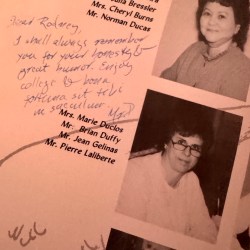
What I learned in that room had very little to do with memorizing declensions and everything to do with how ideas are made. Mr. Duffy taught me that thinking is not a silent, private act that happens first and then gets dressed in words. Thinking is social before it is individual. Ideas are formed through interaction, through dialogue, and only later do those shared ways of thinking move inward, where they begin to feel private and personal. Language was not an afterthought. It was the place where thinking happened.

Mr. Duffy taught that language is not a box that holds ideas. Language allows ideas to form, collide, revise, and grow. Words do not simply name thoughts. They shape them. The structure of language influences what can be noticed, compared, questioned, and remembered. He showed us that expanding language, even by adding a so-called dead one, expands cognition. I did not have an academic understanding of all this then, but I understood it intuitively. He was right.

Because of Mr. Duffy, I became interested in languages and in what becomes possible when more than one linguistic system lives in the same mind. I learned that knowing more languages does not simply add vocabulary. It adds ways of organizing experience. Each language carries its own metaphors, its own logic, its own relationships between time, action, and responsibility. The more languages a person has access to, the more tools they have for connecting ideas, negotiating meaning, and making sense of the world with depth instead of speed.

Mr. Duffy noticed this curiosity about language in me before I did. He shared his thinking about language and life without making it feel like something that needed to be swallowed whole. He taught us Horace, the Roman poet made known by a new generation because of Dead Poets Society, and he used that film to draw us in and teach. He understood that attention is earned, not demanded.

Recently, I found my old senior year book, and inside it he had written that he would always remember me for my honesty and my sense of humor. That line landed harder than it probably should have. He did not praise intelligence or achievement. He named qualities that suggested presence, risk, and a willingness to say what was true even when it was inconvenient.

Looking back now, I understand that what he really noticed was not an aptitude for Latin. He noticed a hunger for connection and a comfort with language as a living thing. He saw the possibility of a life built around words, meaning, and noticing, and he named it out loud. That naming mattered. There are moments when a teacher does not give you something new, but instead reflects something back to you that you had not yet trusted. Sometimes being seen is not about praise. Sometimes it is about recognition arriving early enough to change the shape of a life.

Thank you, Mr. Duffy.

February 2026
M T W T F S S
 1
2345678
9101112131415
16171819202122
232425262728  

Fear and the Motherfucker – Day 22

Prompt – Your first day of school that you truly remember.

The first day of school that I truly remember was fourth grade, and the memory was all due to Mrs. Blue, my new teacher. I came into that year riding the high of third grade with Ms. Mullings, a teacher who made the classroom feel alive and safe at the same time. Learning had felt expansive. Mistakes were part of the process. Curiosity was welcomed. And I am sure she was a witch – both a real witch and a good witch. There were big shoes to fill, but Mrs. Blue arrived wearing none of them. She could not find the stride, the rhythm, or the balance required to lead a room full of children. What she brought instead was pain, grief, and an atmosphere so tight with fear that it pressed against my chest before the first recess of the year.

Her classroom had rules. Rules stacked on rules. Rules with no context and no grace. On the first morning, we were seated quickly and told to listen. This was not an invitation. It was a warning. She began listing expectations of the classroom as if reading a rap sheet of a lifetime criminal. Sit this way. Speak this way. Do not do this. Do not do that. The room grew smaller with every sentence.

Then she introduced the concept of “bad words.” Words we were never to say. She told us there would be zero tolerance for language that did not belong in her classroom. What counted as a bad word, however, was not left to interpretation. She turned to the board and began writing them out in chalk, one by one, with a precision that felt practiced. Fuck. Shit. Ass. Asshole. Bastard. Bitch. Damn. Piss. Dick. Cock. Motherfucker. Prick. Douchebag. Jackass. The list kept growing, long past the point of instruction and well into spectacle. Even sailors would have felt seen.

I sat there stunned. My house rarely swore. My father believed swearing disrespected the uniform, whatever the fuck that meant. Hearing those words written so boldly on a school chalkboard felt illicit and dangerous, like being handed contraband and told not to touch it.

When her imagination finally ran dry, she turned back to us and asked if anyone wanted to volunteer additional bad words she might have missed. She reminded us we were not supposed to say them, which meant no one moved. Fear had already done its work. Eventually, a few hands went up, tentative and shaking, offering words like they were confessions.

Then I raised my hand.

When she called on me, I volunteered “rat bastard.” Mrs. Blue wrote it on the board just as she had with the other words.

That was the first day of school I remember clearly.

Now, as an educator, I think back to what Ms. Blue taught me, even if she never meant to. She taught me how fear shuts down learning. She taught me how control masquerades as structure. She taught me that classrooms are laboratories, and what we model becomes the experiment. I did not learn fourth grade content that day. I learned how not to teach. And some lessons, once learned, never fucking leave.

February 2026
M T W T F S S
 1
2345678
9101112131415
16171819202122
232425262728