Prompt – What did love look like in your home?
Love in my home was quiet…deathly quiet. I never heard it spoken out loud. The physicality that usually travels with the words was absent too. There were not regular hugs between family members. I never saw my parents kiss, embrace, touch, hold hands, or say the words. No one stood with open arms waiting to receive another.
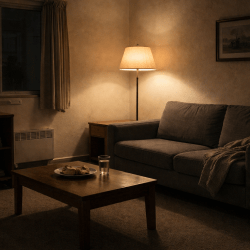
Love was present, but it moved sideways. It slid into the room through ordinary things like dinners made, lights kept on, floors swept, bills paid, and food in the refrigerator. The house stayed in order even when everything else in life refused to cooperate.
Love in my home felt like survival, and it felt like duty. Jesus, tell me you are a military family without telling me you are a military family. Love meant getting up the next day and doing it all again because that was what was expected, and that was what kept everyone together. Constant motion. Keep moving. Keep going. Stay together?
There were no grand speeches of love. There was laughter sometimes, but it often worked as camouflage. There were rules and there were consequences, all unspoken of course. There was the expectation that you toughen up, keep moving, and never fall apart where anyone could see it. Feelings were a private hobby, like stamp collecting. Keep them in a book and do not show them off!
Love also carried shadows in my house. There was anger at times. There were hands thrown. There was tension. There was silence that filled the room so thick that breathing felt like a risk. Doors stayed closed. Words stayed trapped. I learned to read moods and rooms the way meteorologists study tornadoes. I could feel a storm coming long before it arrived. I took cover. I stayed small. Head down!
And yet, there were thin places where love created a spark. Small cracks where love slipped through, quiet and unannounced. A plate of food placed on the table. A blanket tossed my way when I fell asleep on the couch. A hand resting on my shoulder for one second longer than usual. Love never said, I love you, rather, love was being careful not to upset a balance that was always changing.
As an adult, I look back and I name it honestly. Love kept the house upright, but it did not teach me how to feel safe. It did not teach me how to be held without earning it. I learned to survive. I did not always learn how to be loved or to believe I was worthy of it.
So my house now looks different. I say the words out loud. I open my arms. I let laughter fill the room without hiding anything behind it. I tell my children that they matter before they prove anything. I let feelings exist without needing to be translated. I am learning, in real time that love is not only duty and not only survival. Love shows up. Love speaks. Love stays, and lets itself be seen.
And maybe this is the quiet miracle of adulthood. I get to choose a different way. I get to let love speak in a voice that does not whisper sideways anymore.








 Muddled Soma