Synthesizer of Silence- Day 53

Prompt – How you acted around your first crush?

Europe released The Final Countdown right in the middle of my obsession with April, and the timing felt cosmic in a twelve-year-old boy way. Like my feelings for a girl that rarely talked to me but one I had already planned our future together, that opening synthesizer did not ask for permission. It declared itself loud, dramatic and damn certain. Yet despite the promise of movement, nothing actually moved. Beneath the noise sat a single lonely keyboard line, thin and exposed, trying to sound larger than it really was. I did not realize then that the song sounded more like longing than confidence, I just heard possibility. That’s how I acted around April… all launch sequence and no launch.

Like every latchkey child raised on garden hose water and days where supervision was optional, I learned early how to entertain myself. I had a small shitty plastic keyboard and a boombox that could make any room feel like a stage if the volume knob turned far enough. I would sit by the window, watching the street below, waiting for April to pass by. When she did, I would press play and hover my fingers above the keys as if I were the one creating that sound. It was theater without an audience performed for the hope of one.

I did not speak to her. Instead I watched and pretended. I timed things and engineered moments that looked accidental but were fully rehearsed in my head. The performance felt safer than any conversation. Pretending to be impressive required less courage than admitting I had no idea what I was doing.

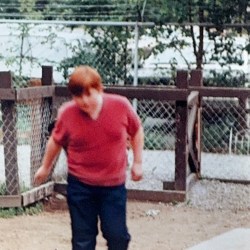
Looking back, that memory carries humor and shame in equal measure. I can see the boy in that window now, red hair glowing in the sunlight, trying to manufacture cool from a keyboard and borrowed sound. What I could not see then was how truly alone every note was. I thought I was reaching toward someone. In truth, I was hiding from being seen…truly seen. I believed attention could be earned through performance. If I looked confident enough, sounded loud enough, appeared interesting enough, maybe April would pause long enough to notice me. Instead, I built a version of myself that did not exist, hands hovering over keys that could not play a single fucking note.

The darker truth beneath the teased hair nostalgia was I did not just fail to connect with April, I practiced and perfected distance. I learned how to stay near someone without ever risking rejection. The countdown never reached zero because part of me did not want it to. Launching meant exposure. Staying grounded meant control.

When I hear that song now, the laughter arrives first, then something quieter follows. A recognition that the boy in that window was already learning how to perform “strength” while starving for authenticity. The music promised departure, yet I remained in place, waiting for permission to be seen. I never left the room. The launch was only noise. The silence afterward was the real story.

February 2026
M T W T F S S
 1
2345678
9101112131415
16171819202122
232425262728  

Orbiting April – Day 52

Prompt – Your Earliest Crush

April was her name. I was twelve. She was beautiful, or at least the memory of her is, softened by distance and the way time edits what it can no longer hold. Her father was a TSgt, and they lived a few houses down from us on Plattsburgh Air Force Base, close enough that it was easy to accidentally run into her when I wanted. Her mother looked like an older echo of April, same features but worn thinner, as if life had pressed its thumb into her for too long. Years of folding a life into cardboard boxes every eighteen months had settled into the lines of her face. Some military wives learned how to pack without leaving bruises behind. She never quite did.

April and I went to the same junior high school but did not have any of the same classes together. I had to see her around the neighborhood if I wanted to see her. I saw her at the bus stop. I saw her when I went to her house to collect payment for the newspaper that month. I saw her when I was walking to the South Side Trails to hang out with the boys. I saw her often; she never saw me.

My crush on April looked like an orbit. I circled her life quietly, measuring my day by the chance of passing through her gravity. I practiced conversations in my head that never left my mouth. I changed the speed of my bike when I thought she might be outside. I learned the dance of pretending not to care while caring so much it felt like a fifty pound secret I carried in my chest.

I do not remember a single real conversation between us. What I remember is the anticipation of a conversation, the sharp awareness of my own body whenever she was near, and the sudden self-awareness about my red hair, about weight, about how to stand or where to put my hands. But, alas, nothing. It was not like she was not cruel. She was simply living her own best twelve-year-old life, and I was learning the quiet math of a one way conversation.

My crush on April never really began or ended; it just faded the way base housing always did, quietly replaced by the next season of trying to belong somewhere. The invisibility was not new. I had been practicing it long before her. She just gave it a face I could not ignore. Looking back now, I laugh a little at that twelve-year-old version of me pedaling past her house like it meant something cosmic. Jesus Almighty. I thought one girl noticing me might repair everything that felt unfinished inside my chest. It was never about April. It was about a boy who wanted proof that he existed outside his own head. The truth is harsher and cleaner now. Nobody arrived to make me whole. I learned to stand there, unseen, and open anyway.

February 2026
M T W T F S S
 1
2345678
9101112131415
16171819202122
232425262728  

Unfinished, Yet Worthy – Day 51

Prompt – Who You Thought You Were Becoming

Reading through old college papers this past weekend felt like opening a time capsule written by someone who believed becoming was a destination instead of a motion. Every paper held a version of me trying to decide who deserved to exist long enough to grow. The theme was always the same regardless of the assignment. The theme was simply becoming. I wanted the chance to stay somewhere long enough for roots to allow something to grow.

Growing up between bases meant growth was temporary and stunted. I learned to adapt faster and grow shallow rather than deep. Peace at all costs became the unspoken rule, which meant parts of me stayed small so the room could stay quiet. I tried on identities the way other kids tried on jackets. Some fit for a season. Some fit well enough to almost feel true. But none stayed long enough to mature into anything stable.

What I wanted most was not a specific identity. I wanted permission to become something recognizable. I believed everyone else had already arrived somewhere solid while I kept circling the runway waiting for clearance to land. I thought if I chose the right role, did the right thing, performed the right version of myself, then maybe love would return, conversations would reopen, and I would finally be seen as someone worth staying for. The moment never came, at least it was not a moment.

Becoming did not announce itself with applause or resolution. It stretched across years instead. It took me across oceans to Japan where silence felt honest for the first time. It carried me into Rwanda where history sat heavy in the air and made my own questions feel smaller and sharper at the same time. It placed me at tables with presidents where power felt strangely human, almost fragile. It sat me in pubs glowing with warm wood and laughter where friendship felt less like performance and more like breath. It led me into churches that promised healing yet left echoes of harm that took years to untangle.

I still have not crossed a finish line; rather, I am content with standing in the space where old versions of me linger while new ones are still learning how to breathe. Past and present speak at the same time, asking different questions with the same voice. Clarity never arrived the way I expected; instead, I know becoming is not a destination. The person I thought I was becoming dissolved somewhere along the way of me actually becoming him. What remains is not fixed, but rather a life being lived. I am less interested now in arriving and more willing to stand in the in between, where memory, grief, and possibility sit side by side and refuse to resolve into anything simple. And for the first time, my worth is mine. It is no longer measured by who stayed or who left; it is measured by the simple fact that I am still here, still becoming, and no longer apologizing for taking up space.

February 2026
M T W T F S S
 1
2345678
9101112131415
16171819202122
232425262728  

Identity: Annotated in the Margins – Day 50

Prompt – Outgrowing an identity.

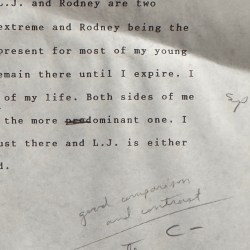
I wrote the paper I mentioned in my previous post before I knew I was actually beginning to draw a map. Back then I thought I was explaining two people, Rodney and Lj, like they were characters in a story. One careful. One loud. One polite enough to be invited to dinner. One reckless enough to laugh at the invitation. I thought I was making sense of opposites. I did not realize I was documenting my survival up to that point.

Rodney was the name that arrived first. It came with expectations and rules and the quiet understanding that good children did not take up too much space. Rodney knew how to observe, how to blend, how to make himself acceptable in rooms that did not always feel safe. Rodney watched more than he spoke. Rodney carried the weight of being seen as good because being good felt like protection.

Lj came later, but he felt older somehow. He showed up in locker rooms and late conversations and moments when the rules stopped making sense. Lj said what Rodney swallowed. Lj used language like a blade and a bridge at the same time. He did not wait for permission. He did not soften edges just to make others comfortable. Back then I called him the “bad” extreme. Now I think he was just more authentic and honest.

Reading that old paper now feels like opening a time capsule written by someone who knew more than he admitted. I can hear the younger version of me trying to organize identity into categories; good versus bad, reckless versus respectable, loud versus quiet. He needed the world to be that simple because he had not yet learned that both voices were trying to keep him alive.

The truth is that Rodney and Lj were never enemies. They were translators for each other. Rodney understood the cost of words; Lj understood the cost of silence. Rodney held the map; Lj lit the match. Somewhere between the two, a writer started to form.

I think about how often I moved as a kid, how every new base felt like an invitation to reinvent myself. Identity was never fixed; it was something I packed in a suitcase and tried on again when the walls changed. That paper captured the moment when I first noticed that reinvention had a pattern. I did not become someone new; I just shifted which part of me was allowed to speak.

There is something tender about the younger voice calling Lj loved or hated but never ignored. I hear a kid trying to make sense of visibility after years of practicing invisibility. He did not yet know that being seen would come with its own kind of grief, that every word spoken out loud would echo longer than expected.

What surprises me most is not how different I sound now, but how familiar that voice feels. The metaphors were already there. The obsession with language was already there. Even the quiet awareness that identity was not a single story but a conversation between versions of myself had already begun.

Maybe this happen when returning to old pages; not to correct them, but to recognize the person who was brave enough to start writing before he knew where the story was going.

Rodney is still here. He always will be. He is the part of me that pauses before speaking, the part that listens for the unsaid. Lj is still here too, louder now, less interested in apologizing for taking up space. They no longer feel like extremes. They feel like witnesses to each other.

If I could speak to the kid who turned that paper in, the one who received a modest grade and moved on, I would tell him this: you were not describing two personalities. You were describing the beginning of a voice that would take decades to understand itself.

And maybe that is the real battle. Not outgrowing Rodney or Lj or any other identity, but learning how to let them all sit at the same table without one trying to replace the others. But seriously, a C-? WTF!

Breadcrumbs of Identity – Day 49

Prompt – Trying on Identities

Identity was never a fixed address. Like moving to a new air base, my identity could shift without warning. If one piece of me did not work at this base, I could always try something new at the next one. New school. New hallway. New version of myself walking in before I even knew who I was supposed to be there. Each new place offered another identity, or at least another mask that helped me survive long enough to figure things out.

Some identities arrived assigned and had little to do with my choice. The smart kid. The quiet kid. The redheaded kid. The husky kid. Labels handed out like Oprah handed out cars. I wore them because they were already waiting for me when I showed up. Other identities were experiments. I tried on invisibility first. It felt safe, like maybe shit would hurt less if I stayed small and unnoticed. That identity lasted longer than most and followed me well into adulthood. But invisibility came with a cost. It protected me from harm, yet it also kept me from being fully seen, even by myself.

College was the first time I realized identity could be rewritten on purpose. I remember writing a paper about it, splitting myself into two voices. Rodney was the rule follower, the kid who survived by staying small and predictable. Lj was the observer, the writer, the one willing to question things even when it pissed people off. I did not know it then, but that paper was less about names and more about giving myself permission to exist in more than one way at the same time.

I tried on other identities too. The class clown. The artist. The writer. The badass. The observer. Each version carried risk. Writing meant stepping out of hiding and leaving proof behind. Observing meant noticing patterns that others preferred to ignore. Being the badass let me channel anger that had nowhere else to go, but there was too much anger for everyone, including me.

Looking back, trying on identities was never about pretending to be someone else. It was a quiet form of survival, a way to test the edges of who I could become without losing the parts of me that refused to disappear through all the moves. Some identities were armor. Some were escape routes. Some were honest attempts at becoming whole. But none of them were wasted. They were breadcrumbs left by a younger version of me who did not yet have the experience to know what the hell I was searching for. I do not see those versions as mistakes. They were thresholds. Thin places where one version of me ended and another began, often without ceremony. Identity was never a single choice. It was a slow accumulation of selves, layered over time, until the noise faded enough for me to recognize the one voice that had been there all along, steady and patient, waiting for me to stop trying to become someone else and finally allow myself to arrive.

February 2026
M T W T F S S
 1
2345678
9101112131415
16171819202122
232425262728  

Alpha, Omega, and the Space Between – Day 48

Prompt – A time your body knew something before your brain did

It was a nondescript Thursday that happened to be the first day of school in 2023. Not exactly a coming of age story, but a coming to terms story, which feels just as honest. I had already worked a full day before heading to teach night school. I had run that program since 2020, and it had become something steady in a world that rarely felt that way in 2023.

The previous director had been human first and an administrator second. The new director was the reverse. She did not even stay long enough to meet the night students. She dropped a bomb instead; if work was not finished that evening, everything would reset. A summer of effort flattened into a policy announcement delivered like a weather report. Bitch felt like a compliment in that moment.

I had been carrying an immense amount of stress in the weeks leading up to this. My mother decided to move from her home of thirty years in the Boston area to here. I was not prepared for the trauma that move would awaken in me. I slipped back into first family mode, trying to please and appease so stress would stay low, as if my father might still explode even though he was no longer in the picture. I had not lived like that since I was seventeen, yet my body slid right back into the role with muscle memory.

I had built something beautiful with my wife and children, yet I allowed myself to be pulled apart again. I tried to hold everything at once. I tried to make sure my mother had no stress. I tried to make sure my wife did not say anything that might upset her. I tried to manage my children, my work, and myself, all while carrying mistrust that never fully healed after my mother stopped speaking to me at thirteen. She moved down to be with my family, yet never truly showed up for my kids. She was doing the same to them as she did to me. Old wounds did not reopen quietly. They tore.

So on that Thursday, after the new director left without meeting the night students, the storm began. Not loud at first. Just pressure in the air. One second I stood in front of my students explaining new expectations, and the next my chest tightened as if invisible hands were testing the limits of my lungs. My breath turned shallow, not because I forgot how to breathe, but because breathing felt like pulling air through a straw that kept collapsing.

Sweat crept down my back. Voices blurred into white noise. The room grew louder and farther away at the same time. My heart pounded like it was trying to outrun memories I had spent years pretending were settled. Heat climbed up my neck. Every nerve decided to clock in at once. There was a strange clarity inside the chaos; my body moved with certainty while my mind stood still, lost several steps behind.

Time stretched thin. My hands went cold. Thoughts scattered like papers thrown into the wind. The urge to escape grew louder than my lesson, so I slipped into the bathroom. Shame narrated every step, whispering that my students could see every crack in me. I stood in front of the mirror and waited. Breath returned first. The white noise softened. My shoulders dropped. And that was only the beginning. It happened three more times that night. Then five days followed where waves of panic stacked on top of each other like surf that refused to break. ER visits. Monitors. Doctors telling me my blood pressure sat at stroke level while I sat there convinced my heart was failing. Medication meant to help triggered an anaphylactic reaction instead. My body did not whisper anymore. It screamed.

Looking back now, the panic was not betrayal. It was translation. My body spoke a language I had ignored for years; exhaustion, alcohol, pressure, grief, silence, and anger. The brain argued for productivity while the body demanded survival. That week forced a reckoning I could not outwork or outthink.

The truth is uncomfortable. My body knew I was unhealthy long before I ever said it out loud. It knew I needed to stop drinking, stop running, and stop carrying responsibility for wounds that were never mine to hold and never my fault to begin with. My body understood that survival required more than performance. It required change. Panic did not arrive to destroy me. It arrived to interrupt the myth I had built around strength. Strength was never the ability to push through trauma as if it were proof of worth. It was the moment I finally stopped long enough to hear the quieter voice inside me, the one that had been trying to pull me back toward myself long before everything began to crack.

February 2026
M T W T F S S
 1
2345678
9101112131415
16171819202122
232425262728  

Transactional Reflections – Day 47

Prompt – The Mirror Years

Mirrors. Another world reflected back, distorted in ways that felt both familiar and foreign. I was never obsessed with the mirror during the mirror years because the distortion was too great to trust. The mirror did not lie exactly, but it never told the whole truth either. It caught my outline but fully missed my context. It held my image still while everything inside me kept shifting.

It is not that I did not care about what I looked like. I cared deeply. I already knew what I looked like because others made sure to tell me. Classmates narrated my appearance while adults tried to soften it with other words, and like the mirror, neither kids nor adults told the whole story.

During those years, I learned to approach the mirror like my family approached houses; transactional in nature. A quick glance to adjust my shirt and then move on. Staying too long invited comparison, and comparison always felt rigged from the start. Red hair, pale skin, and a spare tire around my waist was a hard hand to win with. I stood there sometimes wondering if the person looking back was fixed or temporary, just like the house I lived in for that year.

I guess there was a strange relief in not being obsessed because obsession requires belief. I did not fully believe in the real me or the reflection. However, there were still moments when I lingered longer than planned. Not to admire or to criticize, but to study my real smile versus the one I performed to keep the peace. Those moments felt like secret conversations that no one else could interrupt. The mirror was less about appearance and more about listening.

Of course, the mirror did not give answers and as I mentioned, it was never really about how I looked. It became a quiet witness instead. I learned that my reflection was not asking to be corrected. It was asking to be seen without the noise of everyone else’s language layered on top of it. Through the distortion and my doubt, if I stood there long enough to feel the weight of my own presence, something steadier began to surface. Not confidence. Not certainty. Just recognition.

Eventually I stopped asking the mirror to tell me anything at all. I stood there less often, and when I did, I looked without searching for meaning. The reflection remained incomplete, and maybe it always will be. What changed was not the image, but my willingness to leave it unfinished. I learned that understanding does not always arrive with resolution. Sometimes it arrives as a quiet acceptance that the person in the glass is only one version of the story, and that the rest of me exists somewhere just beyond its frame, moving forward even when the reflection stays behind.

February 2026
M T W T F S S
 1
2345678
9101112131415
16171819202122
232425262728  

Texas Titty Twister- Day 46

Prompt – A comment someone made about your body that stuck.

Before I was a man, I had man boobs. Not a punchline, just a fact that lived under every t-shirt and never in silence. My pecs were far more than mere specks, and my older brother never let me forget it. He was eight years older than me, which meant he was bigger, stronger, and already living  inside a different version of life. I was still trying to play with friends in the yard while he was chasing girls and becoming the kind of guy everyone watched on the basketball court.

He had a way of turning my body into entertainment for himself. He would sit on top of me, grab my chest, and twist hard while laughing, calling it a Texas Titty Twister. Damn, it hurt! The pain was sharp, but what stayed longer was the laughter that followed, like my body existed for his amusement. I had no chance against him.

Being fat already felt like a burden I carried everywhere. My brother made sure the weight felt double, evenly distributed across both tits. At eight years old, I learned quickly that parts of a body could become public property if someone else decided they were funny enough. I remember wanting to disappear, wanting my body to shrink into something invisible so no one could grab it, name it, or twist it into a joke. Even then, I sensed that shame does not arrive loudly. It seeps in quietly and settles where a child does not yet have language to push it back.

We lived in two different realities. He wanted to fuck his girlfriend. I wanted to be left the fuck alone long enough to feel like a kid. The house did not hold those two worlds very well at the same time. Somehow my piece always felt smaller, dimmer, easier to overlook. I learned how to laugh through the tears because that is what kept the peace. And in my house, keeping the peace was paramount. If stress hit the adults, shit hit the fan for the kids. So, it was easier to call it a joke than to admit that it left a mark, both in the moment physically and emotionally for years to come.

Years have passed, and I have not seen my brother in some time. Still, when I do see him, the first image that arrives is not a flashback of a deep conversation or a shared memory of fishing together. It is his face scrunched with laughter, hands reaching down, ready to twist my man boobs right off my body. That is the strange thing about judgment made about a body. It does not fade the way people assume it will. It settles into muscle memory. It echoes through mirrors, locker rooms, and quiet moments when a shirt feels tighter than it should. Memory does not always return as a story. Sometimes it returns as a sensation. Shame.

But it was just a joke, right? Maybe that was true for him. For me, it was a lesson about power, about how easily someone else’s humor can shape how someone else sees their own body. The words and the hands both left impressions that took years to untangle. I have learned since then that bodies change, grow, harden, soften, and carry stories that no one else fully sees. What stuck was never just the twist or the laughter. What stuck was the feeling of being reduced to an amusement instead of being seen as a person.

And maybe that is where healing begins. Not by pretending it did not happen or by excusing it as harmless, but by naming it honestly and giving the younger version of me the dignity he did not get in that moment. My body was never the joke. It was simply a body learning how to exist in a house where strength and tenderness rarely spoke the same language. Now, when I think about that boy, I do not see weakness or shame. I see someone who survived long enough to tell the truth about what it felt like to be seen and unseen at the same time.

February 2026
M T W T F S S
 1
2345678
9101112131415
16171819202122
232425262728  

A Different Brand of Baggage – Day 45

Prompt – Learning what “cool” meant.

Cool, according to younger me, was all about visibility. As someone who had created an entire science and creed around being invisible, confidence and cool had everything to do with being perceived or seen as cool, with the key being seen. I was not cool, or so I thought at the time. I was the kid who followed the rules not just to follow them, but so others would leave me alone long enough for me to be by myself. Later, quietly and often in private, I bucked the system in smaller ways by reading, writing, and thinking – so cool, I know! Somewhere inside all of that, I was cool; however, I did not believe it then and neither did the crowd that measured such things.

As a military kid moving every time the base commander sneezed or shifted the wind, I watched cool from the sidelines before I ever tried to step into it. Each new school carried its own language, its own hierarchy, its own unwritten rules about who mattered and why. There were a few universals about sports and money, but every place crowned a different tribe, and the traits that defined them did not always match the last place. Still, that tribe always seemed untouchable. They walked into a room as though the room had been waiting for them all along. I walked in hoping to pass unnoticed. Red hair, my weight, and my own doubts made invisibility nearly impossible, so I studied cool long before I allowed myself to imagine becoming it.

At first, I believed cool meant rebellion and risk. The kid who talked back. The group that laughed too loudly in the cafeteria. They looked fearless, and fearlessness felt like the opposite of everything I carried. I stayed small, stayed agreeable, stayed quiet enough to avoid friction. Inside, though, something restless kept pressing forward. Every time I watched someone question an adult or challenge a rule that did not make sense, I felt admiration tangled with envy. They looked free, even though many of them were simply bound to a different kind of baggage.

It took years to understand that what I had been seeing was not freedom; it was performance. And sometimes it was armor. The loudest rebellion rarely held the deepest courage. I began to notice “real cool” in quieter acts. The student who asked a thoughtful question when everyone else stayed silent. The friend who told the truth even when it complicated things. The teacher who admitted uncertainty and invited the class into the work of figuring it out together. Those moments did not look cinematic or dramatic, yet they felt grounded in something honest…something cool.

Cool stopped being about defiance and became more about authenticity. It became the willingness to show up fully, even when that meant standing alone for a moment. The people I came to respect as cool were not trying to be different; they were simply refusing to disappear because of their difference.

Looking back, I see that my definition of cool was always tangled up with belonging. I thought cool meant breaking rules because I believed that was the only way to be noticed. What I know now is quieter and more complicated. Cool is not the volume of rebellion; it is the clarity of self. It is the slow decision to speak when silence would be easier. It is the courage to ask questions, not to disrupt for attention, but to understand more deeply.

Somewhere along the way, watching from the edges, I began to ask my own questions. Not loudly. Not in ways that made a scene. Just enough to feel the ground shift under my own feet. Cool stopped looking like rebellion and started feeling like recognition. The loudest people in the room were not always the freest; many of them were just better at hiding their fear in plain sight. What I had once called invisible was never absence. It was observation. It was patience. It was a boy learning how to belong to himself before belonging to any crowd. And maybe that is what cool finally became; not a performance to be witnessed, but a quiet agreement between who I was and who I no longer needed to pretend to be.

February 2026
M T W T F S S
 1
2345678
9101112131415
16171819202122
232425262728  

Not a Replica, Just an Edit – Day 44

Prompt – Something you secretly liked about how you looked.

I spent most of my childhood avoiding pissing people off and staying small and out of the way, and this included staying out of the way of myself. After Alaska, mirrors were no longer friends as I was now “husky,” as the adults called it. I wanted to disappear inside my body that seemingly refused to cooperate. My carrot top red hair walked into the room before I did. Adults called it distinctive. Kids made fun of that distinction. Still, if I am being honest, I secretly liked my hair, just not the color.

It was thick and styled well. There was no strange cowlick that other kids had to use water, gel, and frustration to tame. My hair always cooperated. It feathered and fell into place without much effort, the kind of easy that felt unfair compared to how hard everything else seemed. I complained about the color, but damn, at least it had possibility. Even under certain light it shifted, less fire and more copper, almost calm. My hair belonged to me and not to the people doing the teasing. That realization felt like a small act of rebellion, the kind that stayed hidden in plain sight with a subtle middle finger to all. I hated the attention of my carrot top, but I still appreciated the way my hair moved when I turned my head. That contradiction lived quietly inside me, a private agreement that I would never admit out loud.

My nose was also a feature I secretly liked, but for a different reason. It was not the sharp line and hard angle of my father’s nose. My nose curved differently. There was no harsh slope, no rigid echo of authority staring back at me from the mirror. As a tween and teen, the mirror confirmed that I was not a replica of my father. I was an edit. Hope lived in that small difference. Liking my nose meant I did not have to inherit everything. I could carry pieces forward and leave others behind. That thought stayed with me longer than any insult about my hair ever did.

There were moments when I stood longer than necessary in front of a mirror, dissecting my reflection. I would pretend to adjust something that did not need fixing, knowing I was really searching for proof that I belonged, if nowhere else, at least to myself. I did not feel confident about who I was, but I was damn sure curious about who I was not becoming. Maybe that was the beginning of rebellion; not loud or reckless, just a slow refusal to disappear. Even when I tried to stay small, parts of me kept stepping forward first, red hair and all, as if they already understood what I was still learning; that becoming someone new does not begin with change, it begins with noticing the pieces that were quietly mine all along.